Sports betting margins are thin, fixtures are finite, and your players are spending their casino budget elsewhere. Here’s how to add casino to your sportsbook platform, double your revenue verticals, and lock in player lifetime value permanently.
If you are running a sportsbook-only platform in 2026, you’re operating with one hand tied behind your back. Casino integration for sportsbook platforms isn’t a nice-to-have anymore; it’s the single most impactful revenue decision a B2B operator can make.
Players who bet on sports also play in the casino. The question is whether they’re doing it on your platform or on your competitor’s.
This guide is written for licensed B2B operators, platform product managers, and iGaming entrepreneurs evaluating how to add casino to their sportsbook platform. Here, we will cover the business case, the technology, what to demand from an integration partner, compliance considerations, and global market intelligence.
The sports betting business may sometimes experience a structural problem. It’s
Average sportsbook margins sit between 5 to 8% on turnover. Casino slots run house edges of 3 to 15%. That gap compounds across millions of player sessions.
More critically, sports bettors experience natural dead periods with no live events tonight, no action for your player, no revenue for your platform. A unified sportsbook casino platform eliminates dead hours entirely. The casino operates around the clock, independent of fixture calendars.
The cross-sell opportunity is equally significant when you add casino to sportsbook platform. Industry data shows that sports bettors who are successfully cross-sold into a casino generate 35 to 45% of their total casino GGR from that operator. This is the revenue that simply doesn’t exist on a sportsbook-only platform. Player lifetime value (LTV) climbs by 200 to 300% when a casino is added to the mix.
Every day your sportsbook runs without a casino vertical, your players are building loyalty on someone else’s platform. That loyalty is worth more than any single bet. – Marketing Head, TIGSPORTSBOOK
| Metric | Sportsbook Only | Sportsbook + Casino |
|---|---|---|
| Sessions / Player / Week | 2 to 3 | 7 to 10 |
| Player Lifetime Value | Baseline | +200 to 300% |
| Revenue During Off-Season | Near zero | Consistent |
| Cross-Sell Sports Betting and Casino Revenue | None | 35 to 45% of casino GGR |
| Active Hours / Day | Event windows only | 24 / 7 |
When operators ask how to add casino to their sportsbook platform, they’re usually asking one of two questions:
The answer to both depends heavily on your integration model.
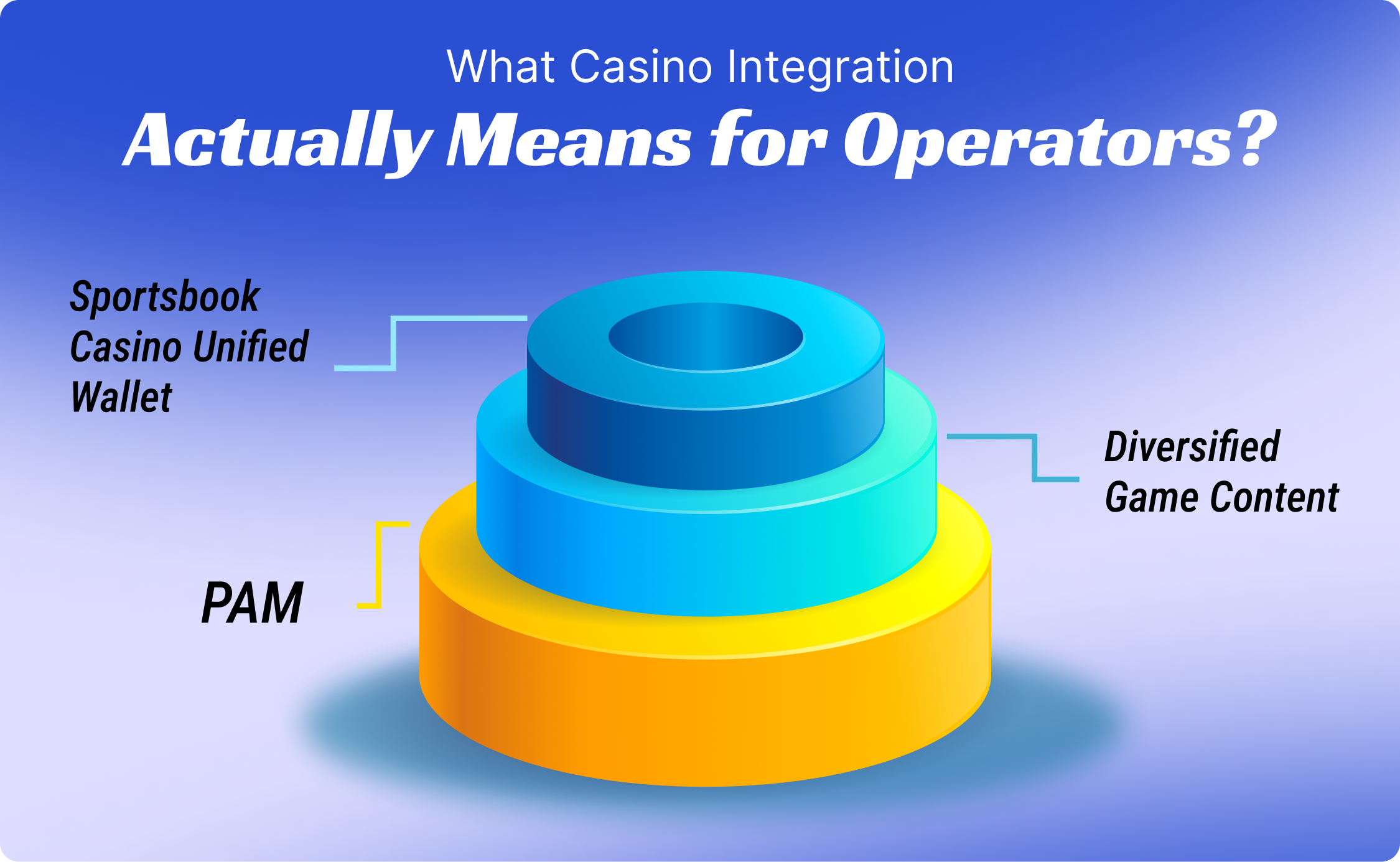
At the core of any B2B casino sportsbook solution is the unified wallet. A single wallet sportsbook casino has a single player balance that is shared across sportsbook and casino with no manual fund transfers, no friction, and no drop-off. This is not optional. Platforms that require players to move funds between wallets see cross-sell conversion rates fall by more than half.
Alongside the wallet sits a shared Player Account Management (PAM) system. One player profile, one KYC verification, one bonus history. When your sportsbook player triggers a casino free spin offer, the PAM handles the cross-vertical bonus logic seamlessly. No siloed systems, no reconciliation headache.
The game content itself is typically delivered via a casino game aggregator API, a single integration point that gives you access to thousands of certified titles from multiple providers. This is the most scalable and cost-efficient approach for operators who want flexibility without managing direct provider relationships.
Not all iGaming platform casino integrations are equal. Therefore, before committing to any B2B casino sportsbook solution, validate these non-negotiables with your prospective casino integration partner.
When adding a casino to your sportsbook platform, the first technical decision is also the most consequential: API integration or iFrame?
These are the two primary models of casino integration for sportsbooks.
API integration connects your platform directly to a game aggregator, giving you full control over UI, wallet, bonusing, and player data.
iFrame embeds a provider’s pre-built casino lobby into your site, which is faster to deploy, but limited in every dimension that drives long-term revenue.
For operators serious about player retention, cross-sell, and GGR growth, API is the clear architecture of choice.
| Criteria | API Integration | iFrame Integration |
|---|---|---|
| Go-Live Timeline | 4–8 weeks | 1–3 weeks |
| Branding Control | Full | None |
| Unified Wallet | Native | Manual transfer |
| Cross-Sell & Bonusing | Full engine | Not supported |
| Mobile Performance | Native rendering | Sluggish |
| Compliance (KYC/AML) | Unified | Fragmented |
| Best For | Long-term GGR | MVP / market testing |
Adding a casino to your sportsbook isn’t just a technology decision; it’s a regulatory one. In most jurisdictions, casino and sports betting require separate license categories. However, several regulators offer combined iGaming licenses that cover both verticals under a single framework. These regulators are
A well-structured unified platform actually simplifies compliance. One player profile means one KYC trail, one AML monitoring pipeline, and one set of responsible gambling controls applied consistently across sportsbook and casino.
For operators managing multi-market exposure, unified compliance tooling is a genuine operational advantage.
The opportunity to add casino to a sportsbook platform varies significantly by region, and so do the requirements. Here’s what operators need to know market by market.
| Region | Key Markets | Regulator | Critical Requirements |
|---|---|---|---|
| Europe | UK, Malta, Germany | UKGC, MGA | Strict RG tools, unified compliance |
| LatAm | Brazil, Colombia, Peru | SPA (BR), Coljuegos | Local payments, PT/ES content |
| Africa | Nigeria, Kenya, South Africa | NLRC, BCLB | Mobile-first clients, local payment rails |
| Asia-Pacific | Philippines, Japan | PAGCOR | Crypto wallets, live dealer, fast loading |
Casino integration is a competitive necessity today. Sportsbook-only platforms are leaving GGR on the table every single day: between events, after final whistles, and during every off-season lull. The operators winning in 2025 and beyond are the ones who have unified their betting and casino verticals into a single, seamless player experience.
The path is clear. A proper casino integration for sportsbook platforms means a unified wallet, a deep game library, cross-vertical bonusing, and compliance tooling that works across both products, not bolted-on iFrames and siloed back-offices.
Choosing the right B2B partner is what separates a profitable launch from an expensive rebuild. TRUEiGTECH is trusted by operators across Europe, LatAm, and Africa as the best casino integration for sports betting operators, delivering a full-stack API-first casino solution that plugs directly into your existing sportsbook infrastructure.
From aggregator API access to unified wallet architecture, bonus engine, and compliance tooling, TRUEiGTECH gives you everything you need to launch, retain, and scale.
Via API aggregator integration, most operators go live in 4 to 8 weeks. Turnkey unified platforms typically take 6 to 10 weeks. Timeline depends on your existing stack, target jurisdictions, and compliance requirements.
In most jurisdictions, yes. However, MGA and Curaçao eGaming offer combined iGaming licenses covering both verticals. The right licensing path depends on your target market.
A unified wallet gives players a single balance across the sportsbook and casino. Platforms requiring manual fund transfers between products see cross-sell conversion drop by over 50%. Frictionless switching is the single biggest driver of casino GGR from sports betting players.
Yes. Via our aggregator API, you curate your lobby from 5,000+ certified titles. Filter by category, provider, RTP, volatility, or jurisdiction eligibility. Full lobby control is standard.
We offer flat-fee SaaS, revenue share, and hybrid commercial structures. The right model depends on your volume, markets, and integration type. All options are presented transparently at the demo stage.
A strong sportsbook platform should include real-time odds integration, low-latency live betting, advanced risk management, compliance tools, scalable infrastructure, multi-currency payments, and analytics for performance tracking.