The global sports betting market is projected to surpass $182 billion by 2030, and the operators capturing the biggest share aren’t building their sportsbook software from scratch. They are going live in weeks, not months, with a white label sportsbook.
Whether you’re a gaming entrepreneur in the US post-PASPA landscape, a Brazilian operator navigating a newly regulated market, or a European business ready to scale, a white label betting platform gives you the infrastructure, licensing support, and branded front-end to compete on day one.
This guide covers everything B2B operators need to evaluate, choose, and launch.
A white label sportsbook is a fully developed, ready-made sportsbook that operators brand and deploy as their own. The underlying technology that includes
And more is built and maintained by the provider. You own the brand, the player relationships, and the marketing control.
Provider Controlled Aspects Technology Infrastructure Licensing | Operator Controlled Aspects Marketing Branding Customer Acquisition |
It’s important to distinguish this from related models. Here are the key sportsbook software models!
For most B2B operators entering competitive markets in 2026, white label is the strategic entry point as it has the lowest time-to-revenue ratio and lowest technical overhead.
Use this table to align your business model with the right platform approach!
| Parameter | White Label | Turnkey | Custom Build |
|---|---|---|---|
| Time to Launch | 2 to 4 Weeks | 4 to 12 Weeks | 8 to 12 Months |
| Upfront Cost | Low | Medium | Very High |
| Brand Control | Full | Partial | Full |
| Sports Betting License | Included | Partial | Self-Managed |
| Scalability | High | Medium | Very High |
| Tech Maintenance | Provider Handles | Shared | Operator Handles |
| Best For | Fast GTM | Mid-scale ops | Enterprise build |
Verdict: For operators targeting rapid market entry with a defined brand, a white label sportsbook solution for operators delivers the strongest ROI in year one. Revisit a custom build only when you are processing 100,000+ active users and require proprietary IP.
The operational model is straightforward. Here’s the typical launch sequence!
Not all white label sports betting software are built equal. Therefore, you must evaluate betting software provider across these critical pillars.
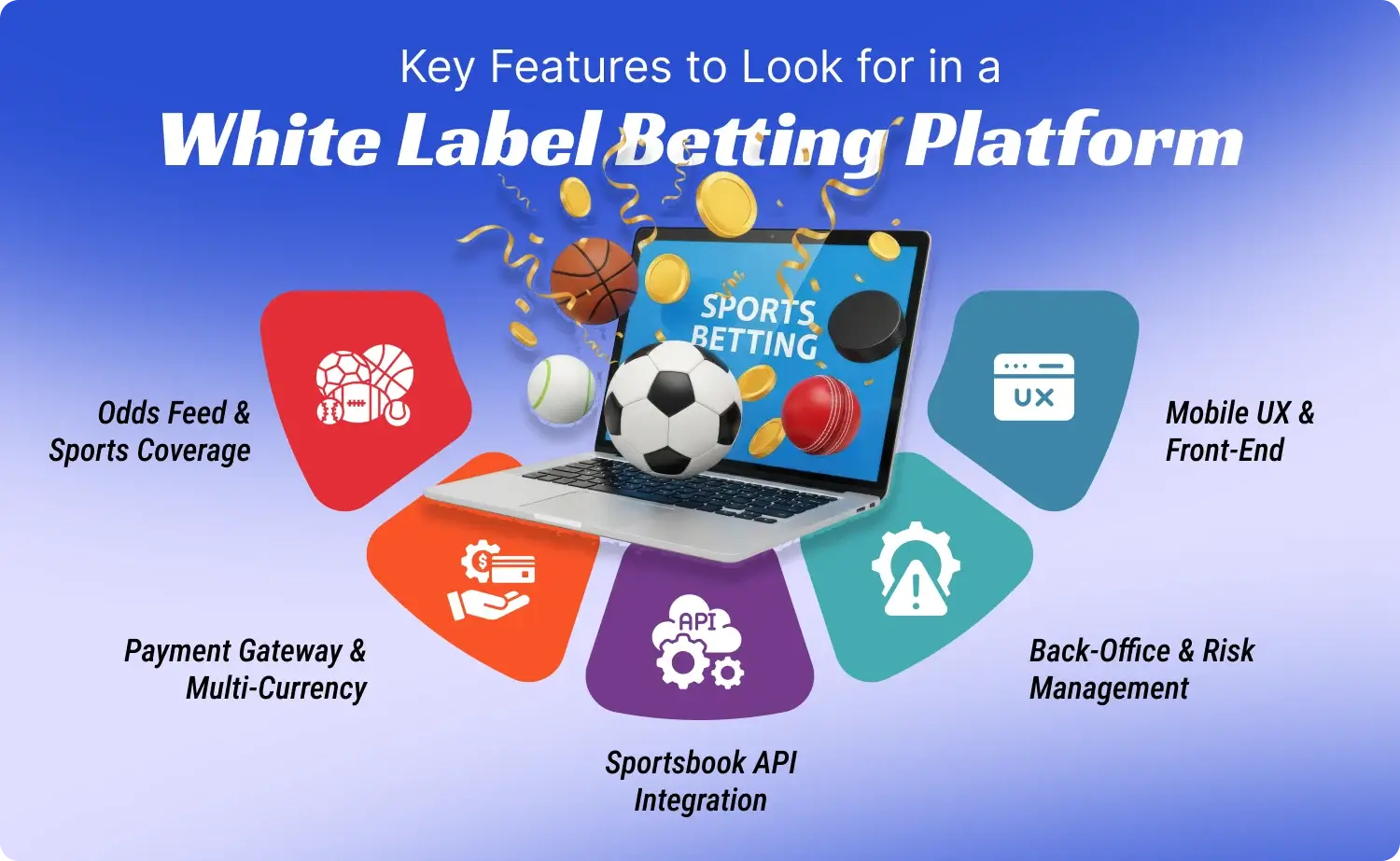
A well-made white label sportsbook software from a professional provider like TRUEiGTECH offers several benefits.
Speed to Market: Go live in as less as 2 to 4 weeks. Competitors building custom are still developing their software when you are onboarding players.
Lower CapEx: Setup costs are a fraction of custom development. You can allocate capital to marketing and player acquisition instead.
Proven Technology: Launch on a platform already processing millions in wagers. No beta bugs, no untested infrastructure.
Regulatory Support: Operate under an established licence framework. Avoid the 9 to 18 month licensing process independently.
Scalability: Top sports betting software providers support operator growth from startup to multi-market scale without re-platforming.
Ongoing Innovation: AI-powered odds tools, new sport verticals, and responsible gambling features are pushed to your platform automatically.
Note: According to industry data points, operators using a ready-made sportsbook model recover setup costs within 6 to 12 months when paired with a disciplined player acquisition strategy.
Launching in the United States?
|
Launching in Brazil?
|
Launching in Europe?
|
Licensing is non-negotiable. Operating without a valid sports betting licence is a criminal offence in most regulated jurisdictions. A reputable white label provider either offers a sub-licence under their own regulatory umbrella or provides structured support for your independent application.
MGA (Malta Gaming Authority)
Gold standard for European market access. | UKGC (UK Gambling Commission)
Required for UK-facing operations; strict consumer protection standards | Curaçao eGaming
Popular for emerging markets; faster issuance, lower cost | SPA (Brazil)
Mandatory for Brazilian operators from 2025 onward | State Gaming Commissions (US)
NJ DGE, PA PGCB, IL IGB, NY GC among others |
Always verify that your chosen provider’s licence explicitly covers your target geography. Sub-licensing arrangements must be documented and disclosed.
Compliance modules for AML, KYC, responsible gambling, and data privacy (GDPR, LGPD) should be built into the platform natively, not bolted on.
This is a long-term technology partnership, not a commodity purchase. Therefore, evaluate prospective betting software providers based on six parameters.
Pro tip: Always request a back-office demo and ask for references from operators in your target geography. A provider’s performance in a different regulatory environment doesn’t guarantee performance in yours.
The white label sportsbook software model wins on every metric that matters at launch, including speed, cost, compliance, and scalability. The variable is your provider. TRUEiGTECH is built specifically for serious B2B operators, delivering a fully licensed, API-first sportsbook platform with deep market coverage across the US, Brazil, and Europe. Real-time odds, multi-currency payments, native back-office, and a dedicated compliance team are standard. No bloated packages, no hidden revenue caps. Launch in weeks. Own your brand. Scale without limits. Book a Demo!
Setup costs typically range from $15,000 to $60,000, depending on the provider, the level of brand customization, and licensing requirements. Ongoing costs are usually structured as a revenue share (10 to 25%) or a fixed monthly platform fee, sometimes combined.
Most operators go live within 4-8 weeks from contract signing, assuming brand assets, payment processor accounts, and KYC documentation are ready. Licensing can extend timelines, particularly for UKGC applications, which average 6 to 12 months. Using the provider's umbrella licence is the fastest route to market.
A pay-per-head (PPH) sportsbook model charges operators a fee per active bettor per week. It's popular for smaller, agent-based operations. A white label sportsbook is a full B2B platform solution with a branded front-end, back-office, and licensing support that is suited to operators targeting direct-to-consumer scale.
Yes, but state-by-state compliance is mandatory. Your provider must hold or support the acquisition of licences in each state where you operate. Not all white label providers have the US regulatory expertise required, verify market-specific compliance credentials before committing.
The leading platforms are built on cloud-native infrastructure and can handle significant volume growth. That said, there is a ceiling at enterprise scale (millions of active users), operators typically transition to a custom or hybrid model for margin optimization and IP ownership. White label is the proven starting point; it's not necessarily the forever platform.