Most of the sportsbook platforms look feature-complete in a demo but that’s not may be enough.
The real test is production: a live environment handling champions League volume, NFL playoff spikes, and sharp action without latency, pricing gaps, or operational friction. This is where the demo vs production gap becomes expensive. Features of sportsbook software shown in staging environments often break, degrade, or simply don’t exist under real load.
This guide breaks down sports betting software features into six non-negotiable categories, structured by operator impact: revenue, risk, retention, and compliance. You can use it as a procurement checklist, a vendor evaluation framework, or a pre-launch audit.
In 2026, the baseline has shifted. What vendors pitched as advanced two years ago, SGPs, AI pricing, real-time streaming is now table stakes. If it’s not production-ready, it’s a liability.
Players don’t engage with your tech stack, they engage with your front-end experience. Weak player-facing features of sportsbook reduces conversion and session time, forcing operators to compensate with aggressive bonuses. That directly erodes margin of sportsbook software development.
A credible platform must support 10,000+ monthly events across global and regional leagues. Operators relying on top-tier-only coverage lose long-tail betting volume and regional player segments.
Sub-500ms odds updates are not optional. Latency creates arbitrage windows for sharp bettors and kills trust for recreational users. Full market coverage, not just match winner drives in-play turnover.
Cash-out increases bet lifecycle flexibility. Operators consistently see higher retention and repeat betting frequency when players can manage positions dynamically.
SGPs are a margin driver. They increase bet complexity and hold percentage while improving engagement. In 2026, the absence of SGP is a conversion blocker.
Integrated streaming is one of the must-have sportsbook platform features 2026 that materially increases session length. More time in session correlates directly with higher bet volume, especially in-play.
These features of sports betting software are critical for US-facing operations and younger demographics. These markets generate high-frequency, low-value bets that are ideal for increasing total handle.
Without this feature, multi-market expansion becomes operationally inefficient and conversion drops in non-primary markets.
Demo vs Production Gap Insight:
Many vendors show deep market coverage in demos using simulated feeds. In production, coverage shrinks due to feed costs or technical limitations. Always verify live event depth and latency metrics as a part of online sportsbook features list.
Risk is where operators either protect margin or lose it. Most sports betting platforms underdeliver here in production. Demos showcase dashboards; real environments expose latency, missing automation, and poor data granularity.
Betting platform features for operators requires live visibility across event, market, and player level exposure. Without automated line movement, liability accumulates faster than traders can react.
Automated segmentation between sharp and recreational bettors enables dynamic limit control. Without it, sharp action erodes the margin quickly.
Manual trading cannot scale across thousands of live markets. AI-based repricing adjusts odds dynamically based on in-game events and global market movements.
A unified, real-time exposure view across all sports and markets is essential. Fragmented visibility leads to delayed decisions and increased risk.
Injury updates, VAR decisions, or abnormal betting spikes must trigger instant suspensions. Delays create arbitrage opportunities.
Providers like Sportradar and Genius Sports offer outsourced trading. For smaller operators, this reduces staffing costs and improves pricing efficiency.
Demo vs Production Gap Insight:
In demos, risk tools appear responsive. In production, delayed feeds and weak automation expose operators to sharp bettors. Always request historical incident logs or real-case scenarios feature in your modern sportsbook software checklist.
Your PAM is not just an infrastructural element, it’s your revenue engine. A weak PAM increases churn, inflates support costs, and limits lifecycle marketing effectiveness.
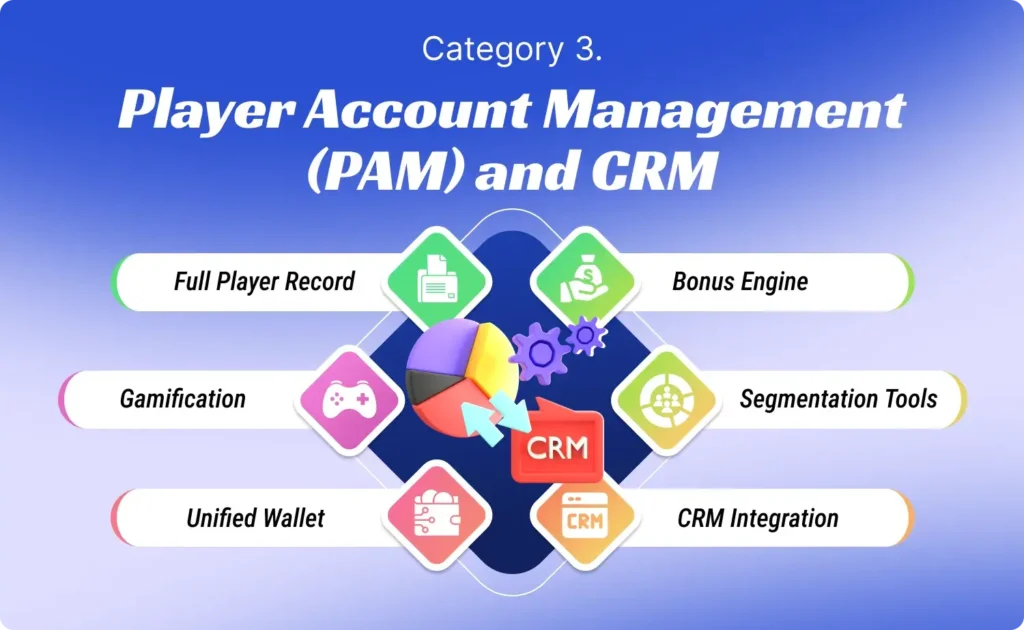
Every user must have a complete profile: bet history, transaction logs, KYC status, and responsible gambling flags. Missing data reduces operational visibility and compliance readiness.
Operators need to segment by behaviour, such as deposit frequency, sport preference, bet size. This drives targeted campaigns and improves ROI.
Bonuses must be configurable without developer dependency. Delays in campaign deployment directly impact acquisition and retention cycles.
Leaderboards, missions, and loyalty tiers increase engagement without relying solely on monetary incentives that directly protects margin.
Automated triggers for churn, reactivation, and VIP management improve player lifetime value (LTV).
A single wallet across sportsbook and casino enables cross-sell, increasing total revenue per user.
Demo vs Production Gap Insight:
Vendors often show flexible bonus systems in demos. In production, configurations are restricted or require backend intervention, slowing marketing execution.
Operators don’t scale through front-end sports betting software features, they scale through operational efficiency. If your sportsbook software features has a poor back office, it increases headcount and introduces hidden margin leakage.
End-of-day reporting is outdated. Operators need live revenue visibility to adjust pricing, promotions, and exposure.
Granular margin tracking by sport, event, and market allows optimization of pricing strategies.
Different teams, trading, support, compliance require controlled access. Poor access management creates operational risk.
Fast resolution reduces support load and improves player trust.
Campaigns must be deployed without code releases. Development bottlenecks slow growth.
Audit-ready, jurisdiction-specific reporting reduces compliance overhead.
Demo vs Production Gap Insight:
Back-office tools are often oversimplified in demos. In production, limited filtering, slow queries, and missing exports become operational bottlenecks.
In the sports betting industry, compliance is not a post-launch task. It must be embedded at the platform level. Operators relying on retrofitted compliance tools face delays, fines, or license rejection.
Automated verification before the first deposit is critical. Manual processes increase fraud risk and onboarding friction.
Deposit limits, self-exclusion, and affordability checks are mandatory sportsbook software features in regulated markets. Integration with systems like GAMSTOP is required under UK Gambling Commission rules.
Ensures bets are placed only within licensed jurisdictions.
Every transaction and communication must be logged. Missing logs are a regulatory red flag.
Operators expanding across markets need flexible compliance rules — not hardcoded logic.
| Area | What’s Verified |
|---|---|
| KYC Process | Identity verification before deposits and withdrawals |
| Responsible Gambling | Deposit limits, self-exclusion tools, and intervention triggers |
| Transaction Logs | Complete audit trail of deposits, bets, and withdrawals |
| Data Security | Encryption protocols and access controls |
| Reporting | Accurate and timely regulatory submissions |
Demo vs Production Gap Insight:
Compliance tools are often mocked in demos. In production, missing integrations or incomplete logs can delay licensing by months.
Infrastructure doesn’t generate revenue until it fails. Then it destroys it.
REST APIs cannot handle live odds efficiently. WebSockets ensure continuous, low-latency updates, critical for in-play betting.
Allows modular upgrades and prevents vendor lock-in. Monolithic systems limit scalability and flexibility.
Vendors must demonstrate concurrent bet capacity and traffic spike tolerance. Ask for documented benchmarks.
Downtime during peak events directly impacts GGR. SLA terms must include penalties.
Auto-scaling via AWS, GCP, or Azure ensures performance under load. CDNs reduce global latency.
Sub-3-second load times are the baseline. Slow mobile UX reduces conversion rates significantly.
Increasingly expected in regulated markets for retention and accessibility.
Demo vs Production Gap Insight:
Most demos run in controlled environments with minimal load. Production failures occur under concurrency, exactly when revenue peaks.
The gap between a polished demo and a production-ready platform is where operators lose margin, players, and sometimes their license.
Any vendor that cannot prove all six categories of sportsbook software features are live, tested, and operational in a regulated environment is a procurement risk. Not “available.” Not “on the roadmap.” Live.
Ask for references from licensed operators. Demand a production-environment walkthrough, not a staging demo.
Before committing, review the full sportsbook software development cost to understand the total ownership. Explore our sportsbook platform capabilities, or learn how to launch an online sportsbook with a structured approach.
In 2026, feature lists don’t matter. Execution does. So, if you are looking for a sportsbook software provider who checks out all these sportsbook software features, TIG Sportsbook is the best pick. Book a demo to get an insight of the production-level product.

