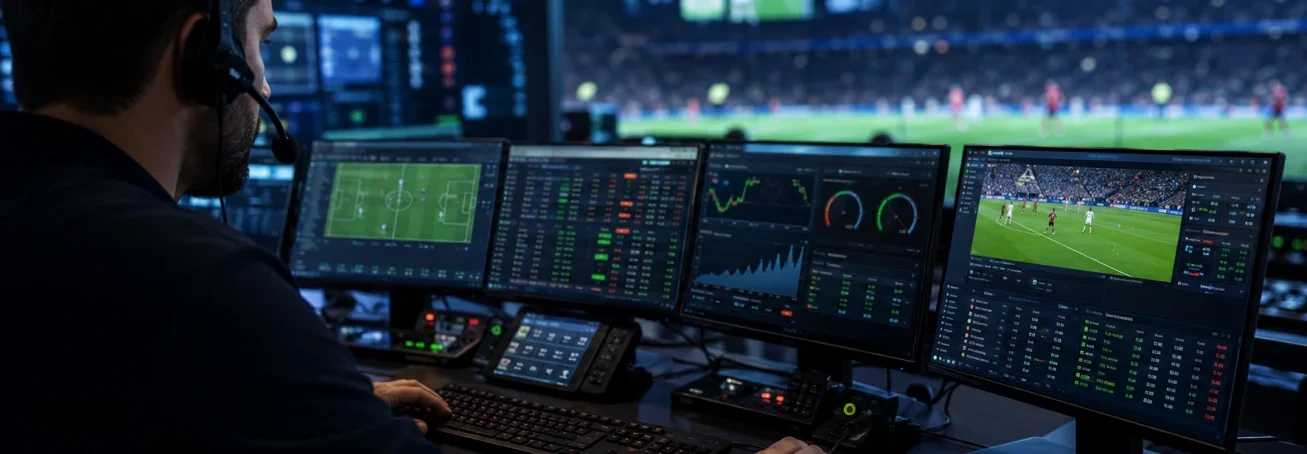
In modern-day sports betting, live betting or in-play betting has become a key driver of engagement as well as revenue. As per industry giants, in-play drives 70% of total sports betting revenues.
While live odds change, markets suspend, and bet acceptance decisions happen in real time, a highly sophisticated technology stack designed to process massive volumes of data with minimal latency works in the backend.
Now, what is a live betting engine?
A live betting engine is the real-time processing system that ingests live sports data, recalculates odds continuously, and delivers updated markets to bettors within milliseconds of on-field events.
For sportsbook operators, the quality of live betting engine architecture directly impacts revenue, profitability, and risk exposure. Faster data processing can improve pricing accuracy, while inefficient systems can lead to stale odds, delayed bet acceptance, and costly liability.
Understanding how a live betting engine works helps operators evaluate vendors, benchmark platform capabilities, and make informed technology decisions. Let’s examine the live betting engine architecture layer by layer.
The Data Supply Chain | Where Odds Begin
Every live bet starts with data, and odds data does not come from TV broadcasts. TV feeds typically have a delay of 7 to 15 seconds due to production & satellite transmission, making them too slow for in-play betting technology.
Modern-day sportsbooks rely on specialized live sports data feed providers, such as
- Sportradar
- Genius Sports
- Stats Perform
And more. These companies collect real-time match information through on-ground data scouts stationed at venues & advanced tracking technologies, such as
- Camera-based systems
- Computer vision systems
The raw data captured by the scouts and technologies is then processed by aggregators. These aggregators standardize information into formats such as XML or JSON. This makes it easier for sportsbook platforms to consume the data, update odds, & manage markets consistently across different sports.
For operators, data quality is just as important as speed. When evaluating a data provider, key service-level agreements (SLAs) should include
- Feed availability
- Data accuracy
- Uptime guarantees
- Low in-play data latency
Even a few seconds of delay can result in stale odds, increased risk exposure, and missed betting opportunities. The faster and more reliable the data supply chain, the stronger the foundation of a live betting operation.
Ready to Build a High-Performance Live Sportsbook?
Pull vs. Push | Why Pre-Match Live Betting Engine Architecture Fails Live Betting?
Let’s understand this with an example.
Before a match starts, serving odds is simple. A user opens the app, their device sends an HTTP GET request to the server, and the server returns the current odds.
Those odds might not change for hours. The data is static enough to be cached at the CDN level. It means that the odds request never even reaches the core server in most cases. Server load stays manageable, response times are predictable, & the architecture scales without much drama.
This is the pull model: The client asks, the server answers, and everyone goes home happy.
After the match goes live, that same live betting engine architecture becomes useless as odds on a Premier League game in-play can shift more than 100 times per minute. This can be due to several match instances, such as
- After a yellow card
- A dangerous attack
- A keeper rushing off his line
If your system is still waiting for clients to ask for updates, you face an immediate fork in the road. It will either lead to clients polling frequently enough to stay current (which increases the concurrent load), or they poll at safe intervals & serve odds that are already history by the time they arrive. Neither of these outcomes is acceptable at scale.
The fix here is that in-play sportsbooks invert the model entirely.
This is the push model: Instead of the client pulling data on a schedule, the server pushes updates the moment they are generated. The client doesn’t ask, it listens.
This shift from a request-response pattern to a persistent, event-driven connection is what separates a pre-match platform from a true live betting engine.
| Feature | Pull Model (Pre-Match) | Push Model (In-Play) |
|---|
| How it works | Client requests data on a schedule. | Server pushes updates as events occur. |
| Latency | Higher, tied to the polling interval. | Sub-second, event-triggered. |
| Server load | Predictable and cacheable. | Higher baseline, but distributed efficiently via WebSockets. |
| Stale data risk | Low (odds rarely change pre-match). | Critical failure if not addressed. |
| Scalability under traffic spikes | CDNs absorb most of the load. | Requires persistent connection management at scale. |
| Best for | Pre-match markets, futures, and outrights. | In-play markets, live betting, and live streaming integration. |
The Core Stack | Ingestion, Kafka, and the Odds Engine
Once live data leaves the aggregator & hits the sportsbook’s servers, the clock is already running.
What happens in the next few hundred milliseconds determines whether a bettor sees accurate odds or a liability-creating lag.
- The entry point is the ingestion service. This is a high-concurrency process that is built to receive the external data feed & immediately route it internally without bottlenecking. It doesn’t compute, settle, or display anything. Its only job is to receive and hand off as fast as possible.
- What it hands off to is Apache Kafka. This is the central message broker sitting at the heart of most enterprise-grade live betting engines. Operators can consider Kafka as a high-speed conveyor belt. The ingestion service drops a raw event, such as a goal, a red card, or a penalty awarded, onto the belt.
From that single event, three downstream services react simultaneously. These services include
The Odds Engine
It recalculates market probabilities instantly, repricing every affected selection.
The Settlement Engine
It checks whether any open bets require immediate resolution.
The Push Service
It packages the updated odds and routes them to connected clients.
The critical design principle here is decoupling.
The settlement process that involves financial logic, account updates, and transaction records is computationally heavier than the odds delivery. In a tightly coupled system, that overhead would delay the odds reaching the frontend. Kafka’s architecture ensures these processes run in parallel, not in sequence. Settlement never blocks the odds engine.
Note: For operators evaluating a turnkey live betting platform, this is worth probing directly:
- What message broker underpins their engine
- What their guaranteed throughput is under peak concurrent load
- Whether their odds delivery pipeline is architecturally isolated from settlement processing
The answer will tell you more about platform reliability than any sales deck will.
Delivering Odds to the Frontend | WebSockets and Delta Updates
Now that we have all the latest odds changes, the next step is to get those odds to the bettor’s screen before the moment passes.
Note that the standard HTTP does not work here. Why?
Each HTTP request needs a handshake that includes a back-and-forth negotiation between client & server before any data moves. When millions of concurrent users are receiving updates dozens of times per minute, it becomes the bottleneck that kills platform performance.
The solution: WebSockets.
It is a protocol that replaces repeated handshakes with a single persistent, two-way tunnel between the user’s device and the server. Once the connection is open, data flows freely in both directions without renegotiation. When the odds engine produces a new price, it travels down that tunnel directly to the bettor’s screen in milliseconds.
At this point, everything looks fine. But the amount of information that travels down the tunnel also matters. If only one parameter changes, but all the info, including every market, every selection, every price, is sent across, it is wasteful.
This is where delta updates come into the picture: only the change is transmitted, not the complete state.
| Update Type | Payload Example | Bandwidth Impact |
|---|
| Full Update | Home: 1.50, Draw: 3.20, Away: 5.00 | High. The entire odds slate is transmitted on every update cycle. |
| Delta Update | Home: 1.55 | Up to 90% lower bandwidth usage. Only the changed odds are transmitted. |
Note: WebSockets aren’t the only option. Server-Sent Events (SSE) offer a lighter-weight alternative for one-directional data delivery, with a meaningful advantage: native auto-reconnection.
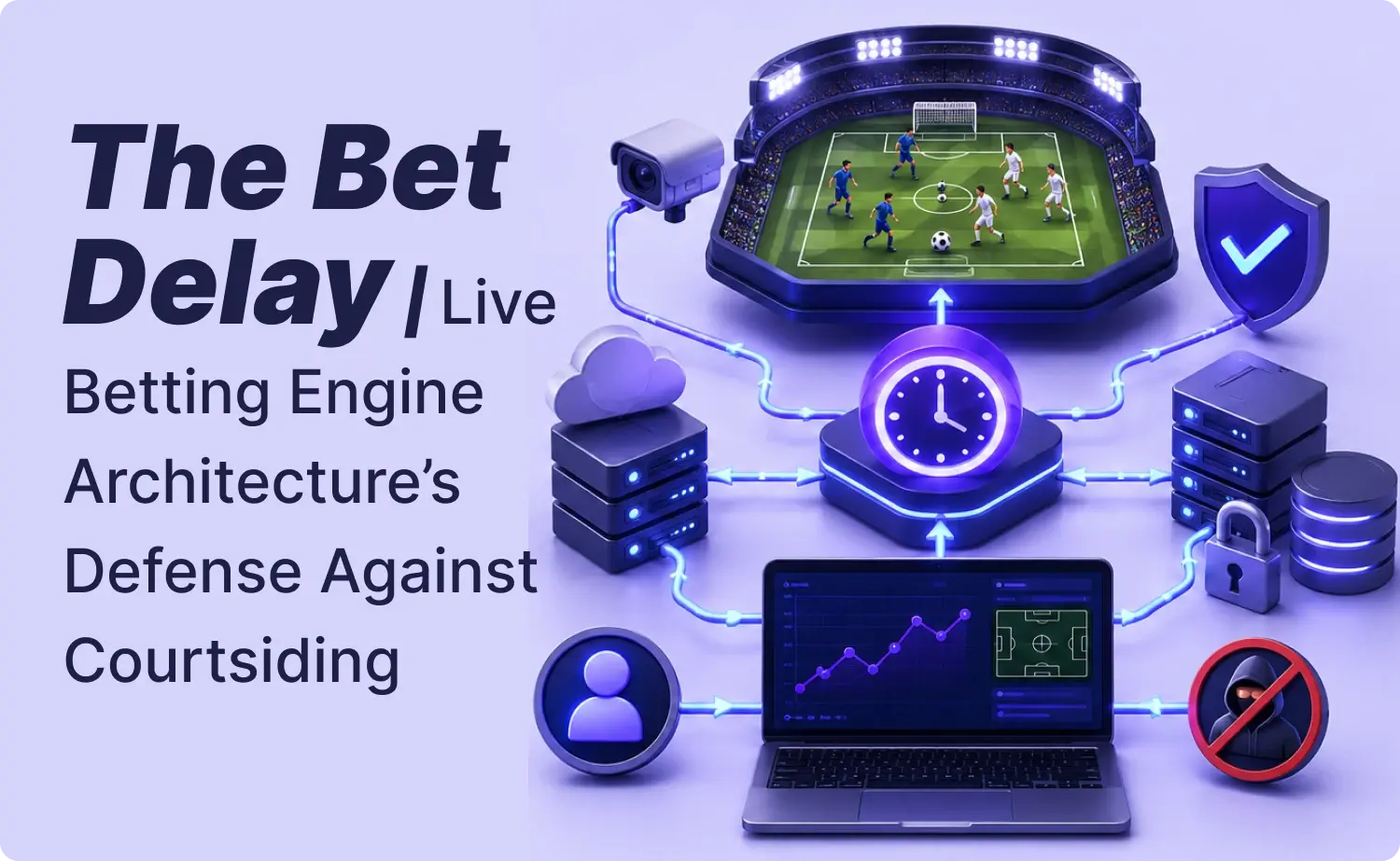
The Bet Delay | Live Betting Engine Architecture’s Defense Against Courtsiding
No live betting engine operates without a defense mechanism at the point of bet acceptance. That mechanism is the bet delay. Note that understanding it is important.
What is courtsiding?
Courtsiding, which is also called latency arbitrage, is the practice of placing a live bet on an event whose outcome is already known to the bettor but hasn’t yet reached the sportsbook’s data feed.
This can happen when a punter physically present at a stadium sees a goal scored 2 to 3 seconds before the operator’s feed reflects it. In that window, they are not predicting an outcome; they are betting on history.
Standard satellite TV broadcasts carry a 7 to 15-second delay, making them useless as a timing tool. But even the fastest aggregator feeds carry a vulnerability window. The bet delay exists specifically to close it.
How the validation queue works:
- Submission: The bettor places a live bet. It enters a pending state immediately.
- Buffer: The system holds the bet for the configured delay period, typically 5 to 8 seconds.
- Check: At the end of the buffer, the engine queries the event stream: did a material event occur while this bet was pending?
- Decision: Clean stream: bet accepted. Material event detected (goal, red card, penalty): bet rejected.
That 5 to 8 second window isn’t arbitrary. It’s calibrated to the realistic latency gap between a physical event occurring and confirmed data arriving from the aggregator feed.
Odds Suspension Mechanism
Odds recalculation gets most of the attention, but odds suspension doesn’t, which is a problem. A poorly configured suspension layer can quietly destroy both margin & engagement.
Markets suspend when the engine detects conditions where accepting bets would create unacceptable exposure. These triggers drive the majority of suspensions.
- High-impact events (a goal, red card, or confirmed injury
- Feed interruption (the data stream goes dark)
- Liability spikes (one-sided betting volume that pushes the book’s exposure past predefined thresholds).
The good thing is that these suspensions can be automated. Threshold-based rules come into play the moment a trigger condition is met or are manually initiated by a trading desk operator monitoring live exposure dashboards.
Enterprise-grade engines support both, with automated rules handling speed and humans handling edge cases.
For businesses, the tension here is real. Over-suspension kills engagement. Bettors who hit suspended markets repeatedly during peak moments churn faster than almost any other friction point.
Under-suspension creates liability exposure that compounds quickly in high-velocity markets.
Conclusion
A live betting engine isn’t a single product. It’s a chain of architectural decisions, each one either compressing latency or introducing it. From the data scout’s finger-tap at the stadium to the odds landing on a bettor’s screen, every layer matters, including ingestion speed, message broker throughput, odds engine decoupling, delivery protocol, suspension logic, and risk integration.
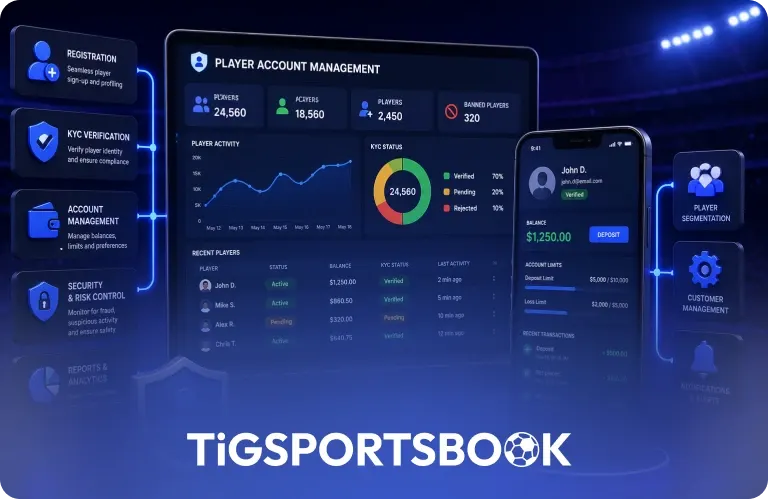
Whether you are evaluating a turnkey in-play sportsbook solution or scoping a build-in-house decision, understanding this stack means you are asking vendors the right questions, such as throughput guarantees, bet delay configurability, PAM integration depth, suspension threshold transparency, etc.
For operators serious about building a competitive live betting product, explore TIG Sportsbook‘s live betting engine and see how the live betting engine architecture holds up at scale.
Launch a Live Sportsbook That Players Trust