


Quick Summary
- An omnichannel sportsbook runs web, mobile & retail on one core: One player record, one wallet, one set of odds, and one back office.
- The hard engineering is in the betting core, where odds parity & event-ID sync decide whether channels truly match.
- Fragmented channels cost money through duplicate players, split liability, manual reconciliation & bonuses that don’t travel.
- Operators with one channel live can retrofit through API integration, embed a module, or replace the platform, trading speed against how unified they end up.
- Build in sequence: Audit player data, set up the wallet, launch digital, connect retail terminals, then unify bonuses. Track success with cross-channel & conversion KPIs.
Running a sports betting business via multiple channels is profitable but challenging. One of the key challenges is disjointed standalone systems & the lack of synchronization between them. The omnichannel sportsbook approach solves this challenge. Unlike the traditional approach, where operators had to manage different channels with separate databases, omnichannel architecture combines them into one.
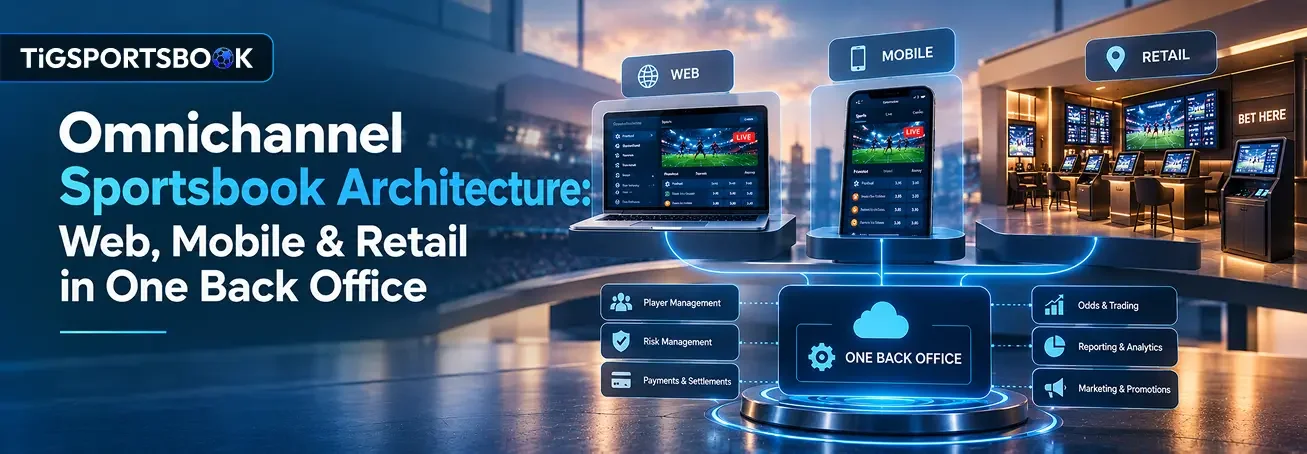
Omnichannel sportsbook architecture is the technical design that connects web, mobile & retail betting to one shared back office. A central API layer links every channel to a single player account, wallet, trading & risk engine, and reporting.
In this blog, we will uncover what an omnichannel betting platform architecture is in detail, along with the layer model, the back-office requirements, and the migration path.
What Omnichannel Sportsbook Architecture Actually Means?
In today’s technologically advanced market, operators think that they are omnichannel, but they actually are not. If you have a website, an app & a few betting shops, it doesn’t mean you are omnichannel.
Running three channels may be easy. However, making them behave like one business is the hard part.
What an omnichannel sportsbook architecture means is that every channel runs on the same core that includes
- One player record
- One wallet
- One set of odds
- One risk engine
- One set of reports
The website, the app & the retail terminal are just front ends that talk to that core through APIs, so none of them keeps its own version of the truth.
Here’s what an omnichannel sportsbook architecture looks like in practice.
A player deposits cash at a retail kiosk on Saturday morning & gets a balance. By lunchtime they’ve opened the app, seen that same balance, and placed a live bet on a match already underway. That evening they walk back into the shop & cash out the winning ticket at the counter. Nothing was reconciled overnight. Nobody in the back office had to match two ledgers, because the system never treated them as three customers.
That’s the real test. If a bet in one channel can’t instantly change what the player, the trader & the compliance team see everywhere else, the setup is stitched together, not unified.
Omnichannel vs Multichannel Betting
Multichannel means parallel systems that each serve one channel. Omnichannel means one core with many front ends.
| Area | Multichannel | Omnichannel |
|---|---|---|
| Player identity | Separate profile per channel, so one person can exist two or three times | One player ID across web, mobile, & retail |
| Wallet | Separate balances per channel, with manual or batch transfers | Single wallet with a real-time balance everywhere |
| Bonus | Channel-specific promotions, with stacking & abuse hard to detect | One bonus engine applying eligibility & wagering rules per player |
| Risk view | Exposure & player behavior split by channel | Unified exposure & player-level risk in one view |
| Reporting | Separate reports reconciled by hand | One data source & consolidated reporting |
| Hardware | Terminals run on a separate retail system | Terminals are another front end on the same core |
Stay Ahead of Sports Betting Market Trends

Why Fragmented Channels Cost Operators Money?
The overall sportsbook software cost is a critical element for a sportsbook operator, and it is increasing silently, and you don’t even know it. Fragmented or siloed channels can leak money in small amounts every day, in places no single dashboard shows. Industry estimates suggest that an omnichannel sportsbook can reduce operational costs by 15% to 30% as compared to broken or fragmented systems.
Here is how money leaks.
Redundant and Duplicate Records
When the shop & the app keep separate customer files, one bettor becomes two. The marketing department counts two acquisitions. The miss: nobody sees that the “casual” app user is also a regular high-staker at the counter
This leads to the acquisition cost being doubled for that user. Moreover, if there is not one record, lifetime value is guesswork. Operators who have invested in omnichannel gambling architecture report 24% higher player lifetime value.
Liability Splits That Attract Risk and Higher Payouts
If the shop & the app each keep their own books, no one sees the total money wagered on a match. Each side may look safe on its own while the combined bets are far too big. You can’t protect against a risk you can’t see.
For example, on the same match, the shop trader sees $20,000 on the home win & thinks that’s fine. The app trader sees $25,000 on the same & and thinks the same. Neither knows the real exposure is $45,000 on one outcome, so nobody adjusts the odds or lays off the bet until the final whistle.
Manual Reconciliation
Matching shop tickets & cash against digital settlements at the end of day can eat a lot of staff hours. It also breaks at the edges; that includes
- Voided tickets
- Late settlements
- Cashier errors
Each mismatch is a dispute or a write-off waiting to happen.
Bonuses and Loyalty That Don’t Travel
A free bet earned online can’t be redeemed at the counter & shop loyalty points vanish in the app. Players notice. They either stop engaging or find ways to claim the same offer twice. Industry numbers suggest that nearly 64% of all fraud in the sector is caused by bonus abuse.
In short, where all of this lands is the acquisition costs. Operators often pay several hundred dollars to acquire each player. On a unified account, that bettor is one customer you acquired once. On fragmented channels, they are a second acquisition you pay for again.

5 Most Important Layers of an Omnichannel Sportsbook Stack
Every omnichannel sportsbook has five important layers. Operators can either build them from scratch or buy the ready-made version. Now, one thing to understand here is that an omnichannel betting platform has all the critical elements under the surface, but most brands focus on the surface part, like the screens and user interfaces.
1. Player Identity & Wallet Layer (PAM)
Everything in an omnichannel sports betting solution starts with one player. A single account, one KYC record, one wallet & one set of limits follow the bettor from the website to the app to the shop counter.
Every other layer in the solution asks for this one thing before it acts. Strong & cross-channel player account management solutions means a deposit made in one channel is spendable in another within seconds, while a self-exclusion applies everywhere at once.
2. Betting Core: Odds, Markets, Trading & Risk
This is the engineering heart or the core of the omnichannel sportsbook architecture stack. The core holds three things:
- One event ID per match
- One set of markets and odds
- One liability book
Every channel reads the same prices & writes bets into the same ledger. This reads easy, but can be harder than it sounds.
If a shop screen shows an old price for even a few seconds after the app has moved, you’ve taken bets at two different odds on the same event. If the odds parity & event-ID sync properly, then only your system is truly unified.
3. Channel Presentation Layer
Web, native app, self-service betting terminal (SSBT) screens & cashier screens are all different views of the single market feed. None of them calculates odds or stores bets. They just display prices & send requests.
Teams often over-invest here, but they need not, because screens are what people see. A polished user interface on a mismatched feed is still a fragmented sportsbook. Keep this layer thin & let the core do the thinking.
4. Retail Hardware & Connectivity Layer
Betting shops can be messy environments. Elements like terminals, receipt printers & cashier POS units have to keep working through patchy internet, power cuts & busy Saturday afternoons.
This takes offline tolerance that allows a cashier to keep selling within safe limits & sync when the connection returns. Besides, over-the-air updates to the software eliminate the need for a technician visit to every shop.
5. Unified Back Office & Reporting Layer
With the betting core at the heart of the system, back-office & reporting play the role of a control panel above everything. Everything, including traders, compliance, finance & support, works from one place:
- One player view
- One risk view
- One bonus engine
- One set of reports
Because every channel writes to the same core, nobody reconciles shop figures against digital figures at day’s end. A morning of spreadsheet work becomes a report that is already correct.
Single Wallet: The Non-Negotiable Foundation
A single wallet in an omnichannel sportsbook software combines multiple channels into one business. When the balance lives in one place, say the app, everything else becomes possible.
- Bet in the shop, cash out on mobile: A player places a ticket at the counter & the winnings land in the same balance that the bettor sees in the app.
- Convert retail voucher into online balance: A cash voucher from a terminal can fund an online account with no separate deposit.
- Free bets & loyalty points travel with you: Bettors can earn a bonus online & spend it at the counter.
The architectural rule is simple. The wallet must sit above the channels, not inside one. If it lives in the web platform, retail becomes a guest that needs constant syncing.
The Retail Channel: SSBTs, Cashiers & Cash
There are many bettors who may not prefer the digital channels as they miss what an actual shop offers, such as
- Cash
- A face-to-face payout
- A place to watch the match with other people
Plenty of bettors prefer to pay in cash & many never open an account at all. A retail channel serves them without asking for a login.
This is where the technical demands might increase for a sportsbook provider. And it is necessary for operators to satisfy these demands because it is a profitable channel and must be a part of the omnichannel sportsbook architecture. Here are the key challenges that operators must address.
- Anonymous & carded play side by side: A bettor may walk in to place a cash bet on an anonymous ticket, while a regular bettor might bet from their account at the same terminal.
- Cash handling: Tills, floats, payouts & end-of-shift balancing must all feed the shared ledger, which can be complicated if the bets are more.
- Printer and scanner integration: A ticket that won’t print or scan is a lost customer. Betting terminals need to print tickets & scan tickets or barcodes for validation. If a ticket cannot print, the customer may be unable to complete the bet. If a ticket cannot be scanned, staff may struggle to verify it or process a payout.
- Degraded-mode operation: The shop keeps selling within safe limits when connectivity drops. For example, if the connection drops during a busy cricket match, the shop needs a defined procedure for handling pending bets, preventing duplicate transactions & syncing records once the connection returns.
- Remote terminal monitoring: Head office sees a fault before the shop reports it. It should be able to identify problems such as a disconnected terminal, printer failure, software crash, or network issue before shop staff reports them.
Anonymous to Registered: Converting Walk-In Bettors With Zero Ad-Spend
Every anonymous ticket is a customer you can’t contact, and ticket-to-account linking changes that. Here is how it happens.
At the counter or SSBT, the player scans a ticket or enters a phone number, & their bet history attaches to a new online account, with their consent & ID verification. They leave the shop already registered, with a balance they can open in the app.
For a retail sportsbook software operator, this is likely the biggest digital acquisition lever. The player has already turned up, paid, and bet, and no ad spend was needed to find them.
Web and Mobile: Parity Without Duplication
Web & mobile are the most well-known channels that the majority of bettors engage with. The risk lies in how they’re built.
If each carries its own betting logic, every new feature gets built twice & the two slowly drift apart.
Therefore, parity is an architecture decision, not a design one. Operators must keep the logic in the core & let web and app call the same APIs, so a new market or bonus reaches every channel at once.
For retail-adjacent markets, the native versus PWA choice depends on the player.
- Native apps offer push notifications, biometric login & an app store presence.
- A PWA installs faster, avoids app store gambling restrictions, and suits low-end devices & patchy data.
Many operators run a native app with a PWA fallback off one API. Teams planning sportsbook mobile app development should settle that API contract first.
Why Does a Unified Back Office Matters in Omnichannel Sportsbook Software?
A unified back office in omnichannel sportsbook software is judged based on how it can help your team from one place. There are several capabilities that a unified back office provides, and these are different from parts that are stitched together.
Consolidated Risk and Exposure
Back office enables operators to see total liability and exposure on every market across web, mobile & retail, and act once. Traders adjust prices or limits in one place instead of chasing three books.
Channel-Segmented Reporting from One Dataset
Filter revenue, margin & player activity by channel without reconciling separate reports. This leaves finance & marketing teams to debate strategy instead of whose numbers are right.
Content Management for Every Screen
With a unified backend, operators can push banners, promotions & market highlights to web, app & terminal screens from a single CMS. This ensures that an offer appears in the app as well as in the shop.
Bonus Engine with Channel Rules
Set include & exclude rules by channel, so an offer can run online only or in-shop only. Eligibility & wagering rules stay consistent everywhere.
Per-channel Compliance Configuration
Apply different limits, ID checks & receipts by channel and jurisdiction, while player-level controls stay global. One audit trail covers all of it.
Role and Shop-Level Permissions
Limit each user to their own shop, region, or function. A cashier sees tickets, a shop manager sees their location & a head trader sees everything.
Real-time BI
Track bets, exposure & cashier activity as they happen, not in next-day reports. This allows the problems to surface while there’s still time to act.
If any capability on this list needs an export, a spreadsheet, or a second login, the back office isn’t unified yet.
Which Integration Path to Choose: Retrofit or Rebuild?
When you are building or scaling an omnichannel sportsbook, operators face a critical architectural hurdle: whether to go for retrofitting the existing system or rebuilding from scratch.
Deciding between a retrofit or a rebuild depends entirely on
- Technical debt
- Market timeline
- How omnichannel your existing foundation is
True omnichannel sports betting is not just about having a website and a retail terminal; it requires more, such as
- A single Player Account Management (PAM) platform with a unified wallet
- Real-time cross-channel risk management
- Synchronized event streams
Here is an overview of both!
Retrofitting
Operators can undertake retrofitting in two ways,
API-First Integration into an Existing PAM
You have a current player account system in place & the sportsbook connects to it through sportsbook API integration for bets, balances & settlement. You keep player data & control. But it will only be unified if your PAM is. If the PAM has been built around one channel, the retail channel ends up as a guest again, patched in with workarounds.
Embedded Sportsbook Module
If you already run a live platform with its own players & wallet, the sportsbook can be embedded into it, often through a sportsbook iFrame solution. This is the fastest route to market. The trade-off is control: the sportsbook provider usually holds the trading, risk & betting data, so your view of the combined player is thinner.
Rebuilding
This is where you (the operator) can replace your existing technology with a platform designed to unify its channels & core services. An operator can replace its separate casino, sportsbook, account, and retail systems with an integrated platform that supports common player records, wallet services, and reporting.
One new stack, one wallet, one back office. It delivers the deepest unification, but it also means the highest cost, the longest timeline, and a migration of live players and balances.
| Route | Speed | Data ownership | Unification |
|---|---|---|---|
| API-first into existing PAM | Medium | High, with the operator | Limited by the existing PAM |
| Embedded module | Fastest | Shared, betting data often with the provider | Lowest |
| Full replacement | Slowest | Full | Highest |
How Does Compliance Work in an Omnichannel Sportsbook?
An omnichannel sportsbook combines various sports betting channels like web, mobile app & a physical store under one core backend. Multiple channels multiply your compliance scope, as each channel brings its own checks, risks & regulator expectations & one player can touch all of them in a single day. The best way to deal with this is to run compliance from the shared core, not channel by channel.
KYC Thresholds Differ by Channel
Cash & card carry different risk, so verification triggers differ. A small cash bet at the counter may need no ID, while an online deposit does. Your sportsbook system should apply the right rule per channel & record every check against one player.
AML on Cash-in
Cash deposits at the counter are a classic money-laundering route. Monitoring has to flag patterns, such as repeated deposits just under a threshold. Moreover, these must also be linked to the same player across channels.
Geolocation for Digital
Online bets must be confirmed as placed inside a permitted area. Retail doesn’t need this, because the licensed shop location answers the question.
Responsible Gambling Limits that Aggregate
Limits may be set per channel, but they must add up to one player. Someone who hits a limit online shouldn’t be able to walk into a shop & carry on. Self-exclusion works the same way.
Jurisdiction-specific Reporting From a Single Ledger
Regulators want their own formats. One ledger lets you produce each from the same data instead of rebuilding figures channel by channel.
If a regulator asks for one player’s full activity & answering takes more than one query, the stack isn’t unified.
Implementation Roadmap of an Omnichannel Sportsbook Software for a Retail-First Operator
Implementing an omnichannel sportsbook is more about sequence than speed. Here is the process, and it has to follow the same order, as every phase builds the foundation the next one needs.
Phase 1: Audit player data (2 to 4 weeks): Find out what you hold, such as
- Ticket records
- Loyalty cards
- Any customer files
Clean duplicates & decide what can legally move into an account system.
Phase 2: Build up the central PAM and wallet (2 to 3 months): Build the one player record & balance that every channel will use. Nothing else should launch before this is stable.
Phase 3: Launch digital on the shared core (2 to 4 months): Web & mobile go live on the same wallet & betting core. Retail still runs on its old system for now, but the foundation is in place.
Phase 4: Retrofit terminals to the unified back office (3-6 months): Connect SSBTs, cashier screens & printers to the shared core, shop by shop. Estate size & hardware age decide the pace.
Phase 5: Unify bonusing and loyalty (1-3 months): Do this last, once players are linked across channels. Cross-channel offers on shaky data cause abuse & disputes.
Note on timelines: Timelines are indicative & may vary with estate size, existing systems, data quality & regulatory approval in your market.
How to Measure Omnichannel Success?
Implementing omnichannel sportsbook architecture is not the end. You must track results to see whether it’s delivering the right outcomes. Here are some KPIs that operators must monitor to measure omnichannel success.
- Cross-channel player ratio: The share of active players who bet in more than one channel.
- Retail-to-digital conversion rate: The share of retail bettors who register an online account & place a bet. As per industry numbers, an omnichannel strategy for betting operators can improve retention by over 25% compared to online-only models.
- Blended CAC: Total acquisition spend divided by new players across all channels.
- Cross-channel ARPU vs single-channel: Average revenue per user for multi-channel players compared with single-channel ones.
- Wallet velocity between channels: How often & how quickly funds move between channels.
- Reconciliation time: Hours spent matching shop & digital figures each day or month. It should trend toward zero.
- Terminal uptime: The share of trading hours each terminal is online and working.
Conclusion
An omnichannel sportsbook isn’t a website, an app & a shop that happen to share a brand. It’s one core serving all three
- One player
- One wallet
- One set of odds
- One risk view
- One back office
The screens are the easy part. What decides success is the architecture underneath: odds parity, event-ID sync, a wallet that sits above every channel & compliance that follows the player. Get those right & retail stops being a separate business and becomes another way into the same one.
If you already run one channel, start with the player data and the wallet, and build outward in that order. TiGSPORTSBOOK holds years of expertise in the industry and a constant tab on future trends. We can help you build a seamless omnichannel experience whether you are retrofitting or rebuilding.
Get your consultation today!
FAQs
An omnichannel sportsbook architecture gives operators one player view and one risk book across channels. This offers:
- Fewer duplicate records
- No manual end-of-day reconciliation
- Consistent bonuses
- Tighter compliance control
- Lower operating costs
An omnichannel sportsbook is a betting platform that runs web, mobile, and retail on one back office, sharing:
- A single player account
- Wallet
- Odds and risk engine
One wallet sits above every channel and holds the player’s balance. A linked shop bet, an online deposit, or a winning payout updates the same balance, visible everywhere in seconds.
It depends on the jurisdiction. Many regulators license retail and online separately or require an online extension to a retail license. Confirm with your regulator and a lawyer before launching.
Multichannel runs separate systems for each channel, including different accounts, wallets, and reports. Omnichannel runs one shared core behind every channel, so players, balances, bonuses, and risk are unified.