

Sports Betting Payment Solutions & Payment Gateway Integration
Sports Betting Payment Solutions & Payment Gateway Integration Table of Contents Today, the gambling process has become easier than before. You place a bet, pay, and if you win, receive


Summary
Starting a bookie business with pay per head means leasing a sportsbook platform & paying $3 to $25 per active player weekly. Year-one fees for 50 active players run $7,800 to $65,000. Legality depends on your jurisdiction; unlicensed bookmaking is illegal in most of the US. Judge providers on uptime, lines, limits, payments, sub-agents & exit terms, then move to turnkey as you scale.
For operators looking for a faster way to enter the iGaming market, there are two options: a ready-to-use software solution or a pay per head sportsbook software solution. Operators often turn to pay-per-head software. Why?
As compared to a custom software (that takes months of development) and a white-label software (that takes 2 to 4 weeks to launch), a PPH sportsbook software is a service model that can go live in 24 hours. In this model, operators pay a weekly fee per active player to access a fully managed betting platform.
The software provider handles the technology, odds feeds, line management, grading, and platform maintenance. The operator focuses on acquiring players, managing settlements, and growing the business.
This PPH sportsbook guide explains how to start a bookie business with pay per head software, how PPH works, what operators actually pay for, how it compares with turnkey & custom sportsbook models & the key factors to evaluate before choosing a provider.
Pay per head, or PPH, is a software service model where a sportsbook software provider hosts the managed betting platform, odds, & grading. The operator pays a weekly fee per active player who bets instead of buying or building software.
The provider supplies
The operator brings the players & controls limits, settlements & collections.
Accounts that don’t bet in a given week cost nothing, so your expenses scale with activity. Most platforms can go live in 24 hours. This is the reason PPH is the usual entry point for agents who already have a player base.
As operations grow, many bookies expand through a hierarchy of agents & sub-agents. Agents oversee player accounts directly, while sub-agents manage their own player groups under the main account. Most PPH platforms provide an agent dashboard to monitor player activity, balances, and weekly handles across the network.
The working of a PPH software includes three key parties:
The player is responsible for bringing in players, managing customer relationships, and handling credit or settlement activities.
The PPH software provider supplies the underlying bookie software, including.
The player places wagers on specific sports events and instances.

Though pay per head software offers a cost-effective solution, some operators still have the question: how much does a pay per head sportsbook cost?
In most cases, the PPH pricing ranges from $3 to $25 per active player per week. This cost depends on factors, such as
Note: Under the pay per head pricing model, you only pay for players who place wagers during that billing cycle. For example, if you have 50 registered players but only 20 are active this week, you pay for 20, not 50.
Despite this, operators must not expect to have all the features. Some features, like casino modules, horse racing add-ons, and dedicated account managers, are charged separately.
The key abstract for operators is that a PPH software can save you costs, provided you have a small user base. Industry estimates show that entry-level operators can save 40% to 60% in their first year compared to licensing or building a standalone sportsbook platform from scratch.

| Per-Head Cost | Yearly Cost |
|---|---|
| $3/head | $7,800 |
| $10/head | $26,000 |
| $25/head | $65,000 |
Real totals run lower because quiet weeks aren’t billed.
Each active player’s net win must exceed their weekly fee plus collection losses. At $10/head, 50 players cost $500 a week before you earn anything.
This means that you need at least $500 in net win, plus enough to cover unpaid balances, just to break even. Fees are due weekly whether you win or lose, so keep a cash cushion before scaling.
The base fee typically covers odds, grading & the agent dashboard. Casino modules, horse racing, and dedicated account managers cost extra. Budget separately for payments, marketing, and layoff accounts.
The first step to learn how to start a bookie business with PPH software is understanding if it is legal or not. Ideally, it depends on where you & your players are located. In most of the US, taking bets without a state license is illegal, whether you handle 10 bets a week or 10k. The 2018 repeal of PASPA let states license sports betting, but it did not legalize independent, unlicensed bookmaking.
Using a PPH provider is no different. PPH is software, not a license & a provider’s offshore location doesn’t protect the operator in the player’s state. Outside the US, rules range from fully licensed regimes to outright bans.
The legal route is a state or national license, or partnering with a licensed operator. Check your local gaming regulator and consult a gambling-law attorney before taking your first bet.
| Factor | PPH Sportsbook | Turnkey Sportsbook | Custom Sportsbook |
|---|---|---|---|
| Launch Time | 24 hours | 4 to 8 weeks | 9 to 12 months |
| Upfront Cost | Minimal | Moderate | High |
| Ownership | None (Leased) | Partial | Full |
| Best For | Agents, independent bookies | Regional operators | Enterprise and licensed operators |
| Technical Responsibility | Provider | Shared between provider and operator | Operator |
| Customization | Limited | Moderate | Extensive |
| Scalability | Good for early-stage growth | High | Highest |
| Regulatory Flexibility | Limited | Moderate | High |
| Maintenance & Updates | Managed by the provider | Shared responsibility | Fully managed by the operator |
| Time to Revenue | Fastest | Moderate | Slowest |
While the sportsbook provider offers the technology, how profitable a pay per head sportsbook is depends on the operator. The management of risk, players, and exposure is the key decision-maker.
Monitor line movement closely and understand why odds are shifting. If you blindly follow every market move or steam chasing, it can expose your book to unnecessary risk. Successful operators know when to follow the market and when to hold their position.
Default wagering limits are rarely optimal. Set betting limits based on player behavior, betting history, and risk profile. Recreational players and sharp bettors should not always receive the same limits, as it can be a liability.
Credit sportsbooks can drive volume but introduce collection and settlement risk. Cash and crypto models reduce exposure because funds are secured before wagers are placed.
Sub-agent structures help scale a sportsbook operation, but they also create layered liability. There are several parameters that should be enforced consistently across the entire network, such as
When action becomes heavily one-sided, a layoff account can help hedge liability with another bookmaker. When it is used strategically, it protects the sportsbook from outsized losses on a single outcome.
Mastering these operational pillars often has a greater impact on long-term profitability than simply choosing the best PPH sportsbook software.
The success of a pay per head sportsbook depends significantly on the fundamentals of sportsbook management. Here are some management mistakes that operators must avoid.
1. Choosing a provider based on price alone
Keep in mind that some of the low-cost PPH services may come with stale odds, limited market coverage, or support gaps. This can hurt profitability & player retention.
2. Treating player accounts as profiles instead of financial ledgers
Poor credit liability management can be a risk. For operators, it can create settlement issues & expose operators to unnecessary financial risk.
3. Failing to classify player types early
Applying the same limits to recreational and sharp bettors can lead to disproportionate exposure and reduced hold percentages.
4. Relying on default platform settings
Generic betting limits and market rules rarely fit every operation, increasing risk and limiting control over sportsbook performance.
5. Scaling player volume before enforcing settlement discipline
Rapid growth without consistent collection and payout processes can quickly create cash flow and liability problems.
One of the crucial steps of how to start a bookie business with pay per head software is to choose the right PPH software provider. Keep in mind that price is the weakest way to compare providers. Test each one against these criteria and get the answers in writing.
| Criterion | What Good Looks Like | Red Flag |
|---|---|---|
| Uptime SLA | Written 99.9%+ with credits | “Best effort” only |
| Line Sources | Named sharp-market feeds | Unnamed or delayed lines |
| Limits Control | Per-player, per-sport limits you set | Default limits only |
| Payment Rails | Cash, credit, crypto, multi-currency | One payment method |
| Sub-Agent Support | Native multi-tier dashboards | Manual workarounds |
| Exit Terms | Player data export, no lock-in | Penalties, no data access |
A PPH is a strong starting point, not a permanent home. Consider moving when:
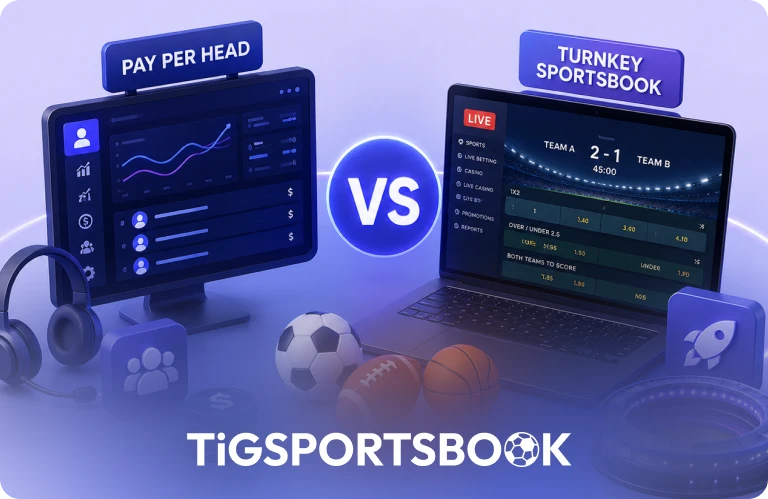
A turnkey sportsbook solution gives you branding & control with a faster launch than a custom build. If you’re not ready to move, PPH sportsbook software keeps you live while you grow toward it.
Learning how to start a bookie business with pay per head software starts with understanding that the pay per head sportsbook operation depends on more than low pricing or fast deployment.
PPH is an infrastructure decision that affects risk management, player experience & long-term profitability. The provider you choose can influence your hold percentage just as much as the quality of your player base. Most importantly, disciplined configuration through effective limits, settlement processes, & risk controls often matters more than platform features alone.
Ready to evaluate a platform built for serious sportsbook operators? Explore TiGSPORTSBOOK’s Pay Per Head Sportsbook Software solution to learn more.
Pay per head (PPH) is a sportsbook software model where bookmakers pay a weekly fee per active player to access betting tools and management features.
Pay per head software typically costs $3 to $25 per active player per week. This depends on:
Being a bookie is legal only where local laws permit it and licensing requirements are met. PPH software does not guarantee legal compliance.
PPH software typically includes:
Some plans also offer live betting and sub-agent tools.
A bookie’s profit depends on betting volume, margins, payouts, player activity, software fees, and operating costs. Revenue does not guarantee profitability.
Yes, many PPH platforms support sub-agent dashboards, player assignments, commission tracking, betting limits, and financial reports, depending on the provider and subscription plan.
Consider switching when PPH fees increase, you need greater branding and data control, or your business requires customized features, integrations, and scalable infrastructure.
Sports Betting Payment Solutions & Payment Gateway Integration Table of Contents Today, the gambling process has become easier than before. You place a bet, pay, and if you win, receive

Omnichannel Sportsbook Architecture: Web, Mobile & Retail in One Back Office Table of Contents Quick Summary Hide Summary An omnichannel sportsbook runs web, mobile & retail on one core: One

Sportsbook Mobile App Development: Cost, Timeline, and Feature Breakdown for Operators Table of Contents Key Takeaways Hide Summary Sportsbook mobile app development costs range from $15,000 (white-label) to $300,000+ (custom