

The year 2026 has officially flourished in the era of the hyper-fast sportsbook. For B2B operators, the landscape has shifted beneath their feet. We are no longer operating in a world where a skilled trading desk and a basic fraud filter are enough to protect the bottom line.
But, between AI-driven betting syndicates capable of executing thousands of trades per second and the sheer explosion of micro-betting markets, the traditional house edge is under risk.
Today, the house no longer wins by default, but it wins by processing data faster than the sharps. The core problem facing many established brands is that legacy risk management in sports betting has become a crippling bottleneck.
In an industry where market sentiment shifts in the blink of an eye, a risk check that takes two seconds is an eternity. By the time that bet is approved, the value of the line has already evaporated, leaving the operator exposed to latency leakage and arbitrage.
The solution lies in a fundamental paradigm shift: moving away from human-led intuition toward machine-led decision intelligence. To achieve sustainable success and protect Gross Gaming Revenue (GGR), operators must rebuild their risk frameworks.
The following blog discusses the sports betting risk strategies that can help operators manage financial risks, fraud risks, technological risks and more.
Common Sportsbook Risks Bookmakers Face | A Multidimensional Threat Landscape
1. Financial Risks & Market Volatility
Financial risk is the most immediate threat to sportsbook liability management. This extends beyond a few heavy favorites winning on a Sunday; it encompasses the black swan events and structural imbalances in the book.
- Liability Concentration: When a disproportionate amount of handle is placed on a single outcome (a popular public parlay), a bookmaker faces massive exposure.
- Inadequate Liquidity: For smaller or mid-tier operators, failing to maintain enough on-hand capital to cover sudden high-volume payouts can lead to insolvency.
- Currency Fluctuations: For B2B operators working across multiple jurisdictions, shifting exchange rates can silently erode profits if a robust hedging strategy isn’t in place.
2. Fraud Risks: The AI-Driven Threat
Fraud in 2026 has moved far beyond simple bonus bagging. Today, bookmakers face organized, tech-savvy entities using automation to bleed the system.
- Synthetic Identities: Fraudsters use generative AI to create perfect fake KYC documents and deepfake biometric data to open thousands of accounts.
- Multi-Accounting & Bot-Nets: Large-scale syndicates use sophisticated scripts to manage gnarled accounts that place micro-wagers across hundreds of identities, staying just below the manual trigger thresholds.
- Payment Fraud: Chargeback schemes and the use of stolen crypto-credentials remain a constant drain on GGR.
3. Technological Risks: The Uptime Imperative
In a digital-first industry, technology isn’t just a tool; it is the business. A single point of failure in the tech stack can be catastrophic.
- System Latency & Outages: A crash during the Super Bowl or a World Cup final doesn’t just lose immediate bets; it drives players to competitors for life.
- Cybersecurity Breaches: As custodians of sensitive financial and personal data, sportsbooks are prime targets for ransomware. A data leak can lead to astronomical fines and regulatory shutdowns.
- API Instability: If the integration between the PAM (Player Account Management) and the odds feed breaks, the bookmaker is left flying blind, often accepting bets on stale lines that have already been settled.
In short, these providers are not just vendors. They are long-term technology partners who directly influence how competitive, compliant, and profitable your sportsbook operation can become.
Manage Risk and Grow Profitably

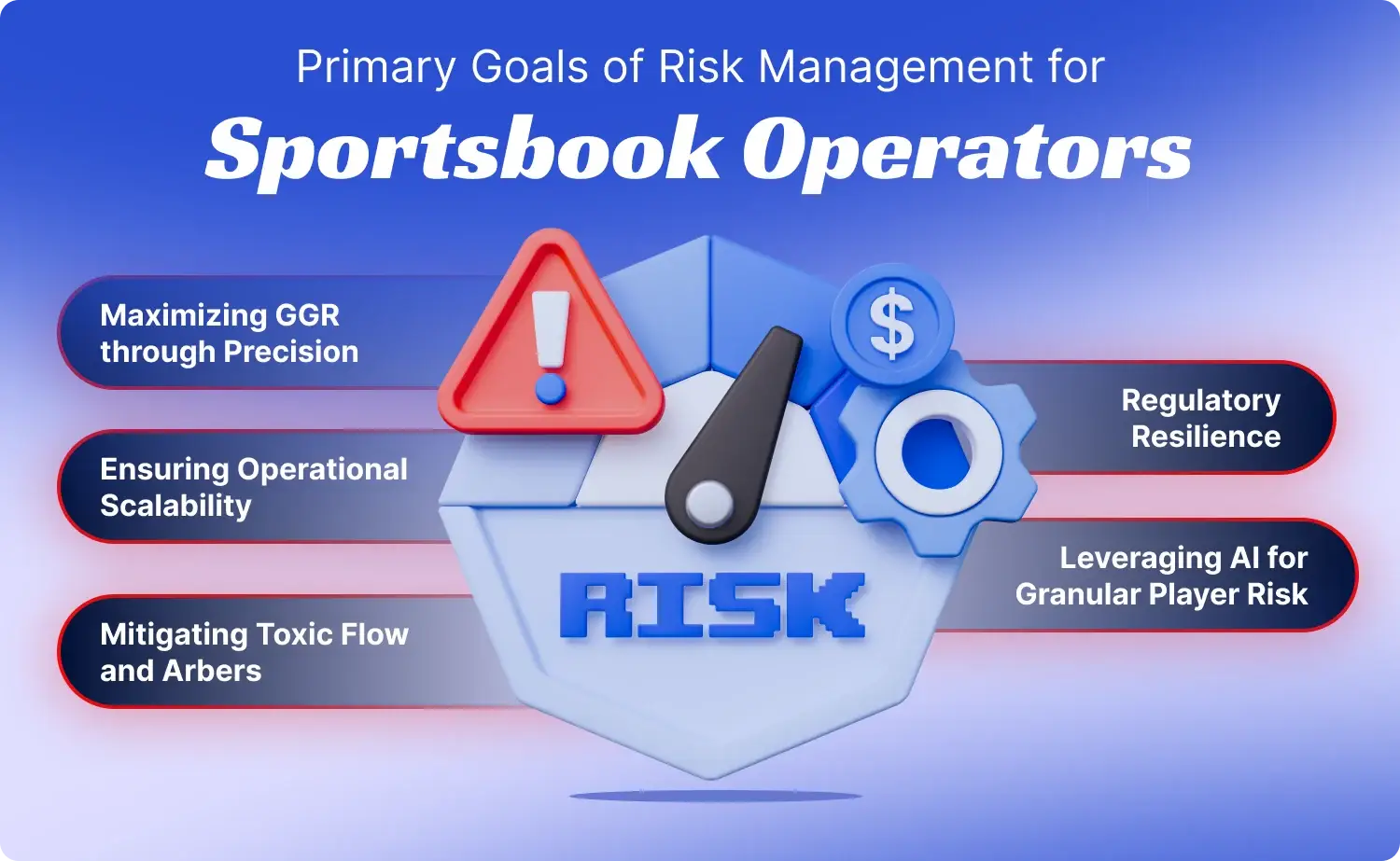
Primary Goals of Risk Management for Sportsbook Operators
For a modern bookmaker, the primary objective of risk management in sports betting has shifted from basic loss prevention to the optimization of every single data point. To remain competitive in 2026, operators focus on these goals.
1. Maximizing GGR through Precision
The ultimate aim is to protect the house edge without turning away profitable volume. By utilizing real-time risk management betting tools, operators can adjust lines dynamically, ensuring that the hold remains stable even during high-volatility events.
2. Ensuring Operational Scalability
A core goal of betting operator risk control is the ability to handle massive concurrency. Systems must be designed to process thousands of bets per second during peak events like the World Cup or Super Bowl without manual intervention or system degradation.
3. Mitigating Toxic Flow and Arbers
Operators strive to identify and segment unprofitable traffic. This involves using automated profiling to detect arbitrage bots and syndicate activity, ensuring that marketing resources and high limits are reserved for recreational players who drive long-term LTV.
4. Regulatory Resilience
Effective risk management ensures 100% compliance with jurisdictional requirements, preventing costly fines and protecting the operator’s license through automated AML and responsible gambling triggers.
5. Leveraging AI for Granular Player Risk
A major priority is the integration of AI in sports betting risk management to move beyond broad-stroke limiting. AI allows operators to analyze behavioral patterns in real-time, distinguishing between a lucky recreational player and a professional syndicate.
This ensures that risk controls are applied surgically, protecting margins while maintaining a high-quality experience for the general user base. By aligning these goals, an operator transforms risk management from a defensive hurdle into a strategic engine for growth.
Get 100% Results With Proven Sports Betting Risk Management Strategies
To achieve long-term profitability, operators must move beyond reactive measures and implement a proactive technical framework. Effective risk management in sports betting relies on the seamless integration of data, speed, and algorithmic oversight.
Here are the core strategies driving success for modern bookmakers.
Dynamic Line Management and Automated Offsetting
Utilizing betting risk management tools to monitor liability in real-time allows for automated odds adjustments. When the system detects an imbalance in the book, it shifts the lines or utilizes offsetting (hedging) to reduce exposure on high-liability outcomes, ensuring the house edge remains intact.
Predictive Sports Betting Risk Analysis
Instead of looking at past losses, operators use predictive modeling to simulate thousands of match outcomes. This allows for anticipatory risk control, where limits are adjusted based on the projected volatility of a market before a significant betting spike occurs.
Tiered Player Segmentation
A sophisticated sportsbook risk management strategy involves moving away from binary bans. By segmenting players into tiers, such as Recreational, VIP, Semi-Sharp, and Professional, operators can apply surgical limits. This keeps recreational players engaged while restricting the drain from arbitrageurs.
Real-Time Latency Monitoring
Operators must audit their API feeds to prevent latency leakage. By ensuring that odds updates are processed in under 100ms, bookmakers can block courtsiders and bots that attempt to place bets on events that have already occurred but haven’t updated in the system.
Automated Bonus and Promotion Abuse Filtering
Fraudulent multi-accounting for bonus exploitation is a significant drain on GGR. Implementing device fingerprinting and behavioral analysis ensures that promotional spend is allocated to genuine users, protecting the marketing budget from syndicate gnawing.
Algorithmic Sharp Tracking
Modern risk management in sports betting involves using “Sharp” bettors as market signals. By tracking the bets of high-IQ users, the system can follow the money to identify soft lines and adjust the global book accordingly, essentially using the winners to sharpen the house’s own accuracy.
How TIGSPORTSBOOK can Help With Risk Management in Sports Betting?
At TIGSPORTSBOOK, we specialize in transforming risk management from a defensive necessity into a high-performance growth engine. Our infrastructure is engineered to handle the zero latency demands of 2026, ensuring your margins are protected even during the most volatile betting events.
Here is how we empower operators with advanced betting operator risk control.
- Autonomous Risk Management: Our AI-driven engines automatically flag high-risk bets, suspicious patterns, and market exposure threats, allowing for 24/7 protection without manual intervention.
- AI-Based Player Profiling: We smartly segment users by behavior and risk level. This allows you to personalize limits and offers, identifying “Sharps” before they impact your GGR while rewarding recreational VIPs.
- Real-Time Odds Adjustment: Our software dynamically recalibrates odds based on market trends and volume spikes, ensuring your lines remain sharp and your liability is always in check.
- High-Performance Scalability: Engineered for peak traffic, our platform supports 1M+ concurrent users and maintains zero-latency performance during high-stakes events like the World Cup.
- Anti-Fraud & Anti-Collusion Systems: We utilize advanced device fingerprinting and behavioral analytics to detect multi-accounting rings and bonus abusers at the point of entry.
- Compliance-First PAM: Our Player Account Management (PAM) system integrates built-in KYC, AML, and responsible gaming controls, making your platform audit-ready for global jurisdictions.
Are you ready to optimize your sportsbook’s performance?
FAQs
Reducing latency to <100ms prevents line-shopping and courtsiding. By closing the gap between real-world events and odds updates, you stop "Sharp" bettors from exploiting stale prices, directly protecting your gross margins.
Yes. AI analyzes betting velocity, stake patterns, and market timing to create behavioral "DNA." It identifies professional syndicates within a few bets, allowing you to limit toxic flow while keeping recreational winners engaged.
Our platform utilizes cloud-native auto-scaling to handle over 1 million concurrent users. This ensures risk checks and bet processing remain instantaneous, preventing system crashes or delayed liability updates during peak betting windows.
Absolutely. We use advanced device fingerprinting and behavioral biometrics to link related accounts. Our system flags ghost networks and synthetic identities in real-time, ensuring your marketing spend reaches genuine recreational players only.
Modular architecture allows you to hot-swap or upgrade your risk engine without rebuilding your entire platform. This agility lets you integrate the best specialized tools for fraud or analytics, keeping your tech stack future-proof.
A strong sportsbook platform should include real-time odds integration, low-latency live betting, advanced risk management, compliance tools, scalable infrastructure, multi-currency payments, and analytics for performance tracking.