Imagine this!
Two operators. Same market. Same launch week. Nearly identical sportsbook platforms on paper.
Three years later, one is sitting on a proprietary sportsbook platform worth millions, customizing features on demand, expanding into new jurisdictions without asking permission, and keeping every dollar of NGR the business generates.
The other is still paying 15% of gross revenue to a vendor they technically cannot leave, waiting six weeks for compliance updates, and running a product roadmap that belongs to someone else.
The variable was never the odds feed, the UI, or the marketing budget. It was source code ownership sportsbook software.
This article breaks down what sportsbook software source code ownership actually means in practice, what operators silently give up when they don’t have it, and the point at which owning your platform stops being a preference and becomes a non-negotiable business decision.
What Makes a Sportsbook Platform Truly "Bitcoin-Ready"?
When new operators evaluate a new platform, they assume that they are buying sportsbook software, but that is not actually true.
In reality, there is a fine difference between software access and ownership. Most of the SaaS providers offer white-label or licensed sportsbook platforms with the right to use the software, not the software itself.
In this case, the vendor retains
- The intellectual property
- Controls the codebase
- Determines how, when, or even if you can customize the platform
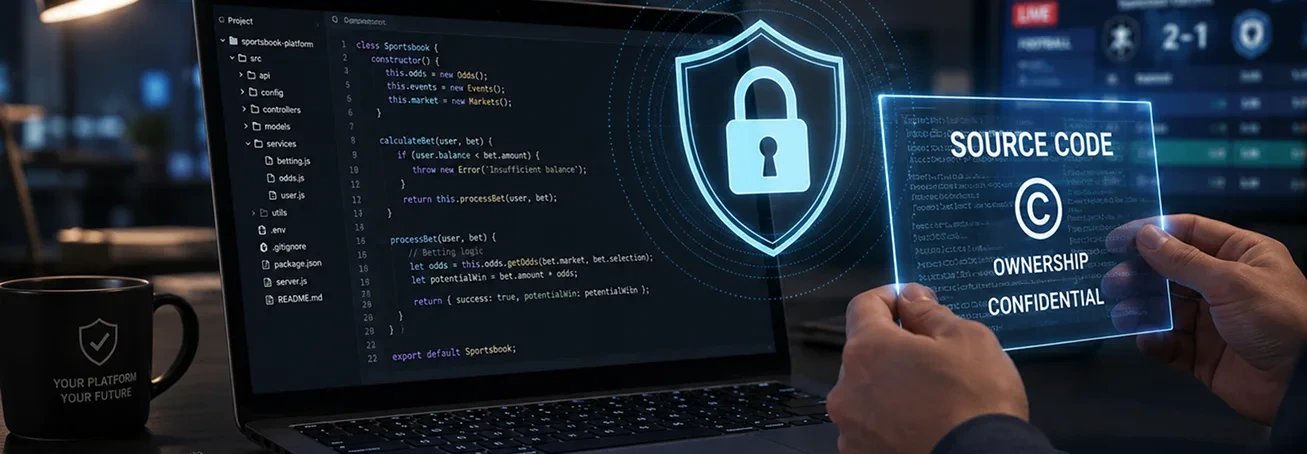
True source code ownership in sportsbook software works differently. The operator receives the complete codebase along with the intellectual property rights, enabling them to
- Modify features
- Integrate third-party services
- Host the platform independently
- Rebrand and commercialize it without requiring vendor approval
This level of sportsbook software IP rights gives operators complete control over their technology and significantly reduces the risk of sportsbook vendor lock-in.
The distinction becomes especially important when circumstances change.
If a vendor increases licensing fees, changes its commercial model, is acquired by another company, or ceases operations altogether, operators relying on a licensed platform have little legal control over the technology powering their business.
But operators who own their sportsbook platform retain complete autonomy over future development, infrastructure, and strategic decisions.
Core Definition: Source code ownership in sportsbook software means the operator holds full intellectual property rights to the platform codebase, including the right to modify, host, integrate, rebrand, or resell it without ongoing vendor permission, licensing dependency, or operational restrictions.
Stay Ahead of Sports Betting Market Trends
What Operators Actually Give Up Without Code Ownership?
Choosing a source code ownership sportsbook software isn’t just a technical decision. It affects profitability, flexibility, & long-term business value.
Here’s what operators often sacrifice without realizing it.
Revenue Erosion
Yes, a white-label or licensed platform may appear cost-effective initially, but recurring revenue share quickly compounds.
If you have a €500,000 in monthly NGR, a 10% to 20% vendor share means €50,000 to €100,000 leaving your business every month. Over time, this significantly increases your total cost of ownership (TCO) & limits reinvestment in growth.
New Features Locked to Vendor Roadmaps
Player expectations evolve rapidly with innovations, such as
- Crypto wallets
- AI-powered personalization
- Micro-betting
Without sportsbook software source code, every enhancement depends on the vendor’s release schedule. Waiting months for critical features means losing valuable competitive advantage and reducing operator autonomy.
Compliance Rigidity
In the world of sports betting, every regulated market has unique requirements. Whether adapting to AML & KYC obligations in the UK, Germany (GGL), or Ontario, operators without access to the underlying codebase must rely on vendor timelines.
Operators who own their sportsbook platform can implement regulatory changes faster and maintain greater compliance agility.
Migration Costs and Vendor Lock-In
The longer you rely on proprietary infrastructure, the harder it becomes to leave. Platform migration often involves
- Rebuilding integrations
- Transferring player data
- Reconfiguring payment systems
- Enduring operational downtime
This is how sportsbook vendor lock-in develops. It turns what should be a scalable technology investment into an expensive long-term dependency.
The TCO Reality: When “Cheaper” Licensing Becomes Expensive
Evaluating platform costs based only on launch expenses ignores the bigger financial picture. The total cost of ownership (TCO) includes multiple elements, such as
- Recurring revenue share
- Licensing fees
- Upgrade costs
- The long-term impact of sportsbook vendor lock-in
Important Note: As revenue grows, these recurring payments can quickly exceed the cost of building a platform you fully own. By the second or third year, operators generating consistent NGR often discover they have paid far more in vendor fees than they would have spent on a one-time investment in custom sportsbook software ownership.
Unlike licensed platforms, a turnkey solution with source code ownership, typically ranging from $150,000 to $600,000. This eliminates ongoing platform revenue share while giving operators complete control over their technology, intellectual property, and future growth.
| Comparison | White-Label / SaaS | Source Code Ownership (e.g., TIGSPORTSBOOK) |
|---|
| Upfront cost | Low | High,but one-time fixed investment |
| Ongoing cost | 10% to 20% NGR + monthly licensing fees | None |
| 3-year cost (at €500K monthly NGR) | €1.8M+ in revenue share | Fixed development cost only |
| IP ownership | Vendor retains ownership | Operator owns 100% |
| Customization ceiling | Vendor-defined | Unlimited |
| Hosting control | Vendor-controlled | Operator-controlled |
| Third-party integrations | Limited by vendor | Unlimited |
| Vendor lock-in | High | None |
Who Actually Needs Source Code Ownership for Sportsbook Software?
A common misconception is that source code ownership in sportsbook software is only valuable for large enterprise operators. In reality, the need of this arises much earlier.
Growing Mid-tier Operators
These operators have validated their business model eventually reaching a point where recurring revenue share becomes a significant drain on margins.
Owning the sportsbook software source code allows them to improve profitability while building a long-term digital asset instead of funding a vendor’s growth.
Multi-jurisdiction Operators
Operators benefit from greater compliance agility. Expanding into markets with different licensing, AML, KYC, payment, & responsible gambling requirements becomes faster when they control the codebase rather than waiting for vendor updates.
B2B Platform Builders
Here, operators have the strongest case for custom sportsbook software ownership. If your goal is to power sub-operators, launch your own white-label offering, or monetize your platform, full sportsbook software IP rights are essential.
Without ownership, you cannot legally resell or commercialize the technology.
With all of this, if you are a pre-revenue startup or testing a new market, a turnkey or white-label platform can be the fastest route to launch. The key is recognizing when it’s time to transition from renting technology to own your sportsbook platform.
That’s where TIGSPORTSBOOK’s bespoke sportsbook software solutions provides a future-ready alternative, delivering
- Full ownership
- Unlimited customization
- Complete operator autonomy without ongoing platform dependency
What to Look for in a Source Code Ownership Agreement?
Not every vendor who is advertising source code ownership sportsbook software actually transfers ownership.
Before signing any agreement, review the contract carefully to ensure you are receiving genuine sportsbook software IP rights, not just extended usage permissions.
Green Flags
- Full intellectual property transfer upon project delivery, backed by clear legal documentation.
- No ongoing licensing fees, royalties, or revenue share after the platform is delivered.
- Self-hosted or any-host deployment freedom, allowing you to choose your own infrastructure provider.
- The right to modify, integrate, resell, or sub-license the platform without requiring vendor approval.
Red Flags
- “White-label ownership” language, where you own the branding & not the underlying codebase.
- Revenue share tied to NGR, creating perpetual vendor dependency.
- Vendor-controlled hosting with no clear migration or exit strategy.
- Source code escrow instead of source code delivery.
One distinction many operators overlook is the difference between source code escrow and full ownership.
Escrow simply means the code is released under limited circumstances, typically if the vendor goes out of business or breaches the agreement. It does not give you operational control.
True custom sportsbook software ownership means receiving the complete codebase and intellectual property from day one.
TIGSPORTSBOOK’s Approach to Source Code Ownership
TIGSPORTSBOOK’s custom sportsbook development model is built around a simple principle:
Operators should own the technology they invest in.
Instead of licensing access to a proprietary platform, TIGSPORTSBOOK delivers the complete sportsbook software source code and transfers full intellectual property rights upon project completion. There are
- No ongoing platform licensing fees
- Recurring revenue share obligations
- Vendor-imposed development restrictions
Operators retain the freedom to self-host, integrate third-party services, customize the platform, & continue evolving their bespoke sportsbook as their business grows.
If you are evaluating custom sportsbook software ownership, explore TIGSPORTSBOOK’s bespoke sportsbook solutions to understand how a fully owned platform supports long-term growth and operator autonomy.
Conclusion
Source code ownership in sportsbook software isn’t just a contractual detail. It’s a strategic business decision for businesses of today. It determines whether you are building a proprietary digital asset that grows in value or funding a long-term vendor relationship through recurring fees and platform dependency.
If your goal is to scale with complete control over your technology, compliance, & future roadmap, now is the time to evaluate a platform you actually own.
Talk to TIGSPORTSBOOK about building a sportsbook you truly own. Book a Demo today.
Are you ready to optimize your sportsbook’s performance?