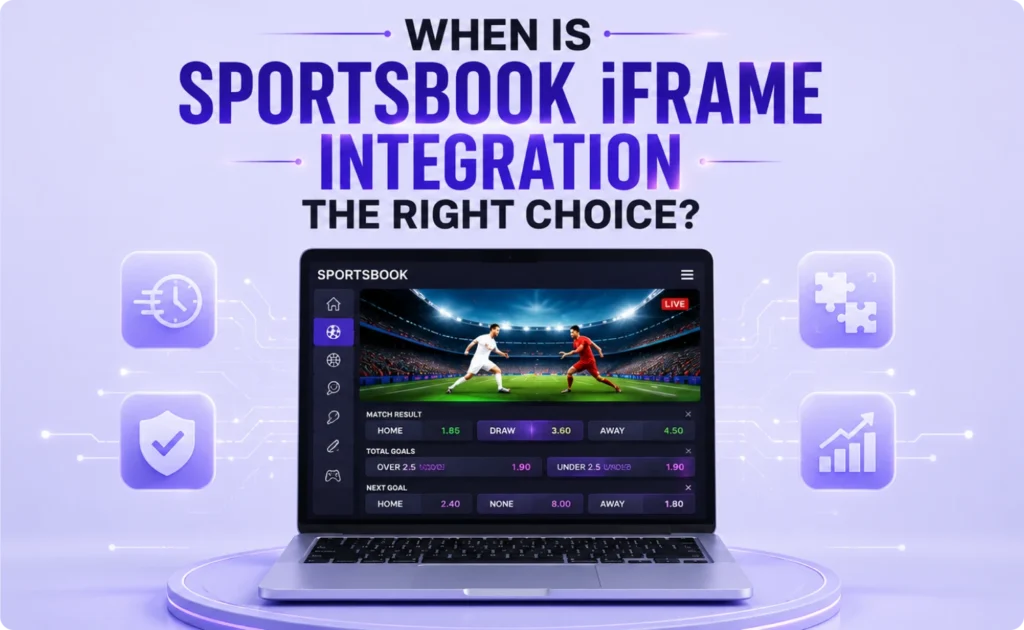
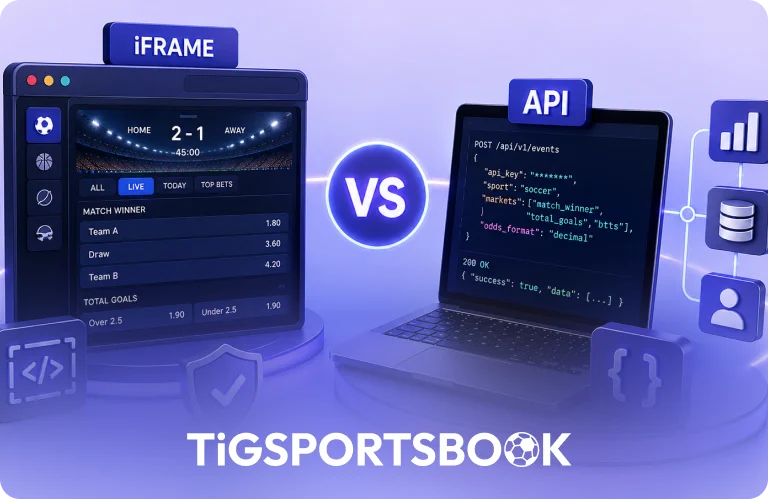
If you are an existing operator adding sportsbook as a vertical, choose iFrame if you need to launch in under 30 days or less, have no dedicated sportsbook engineers, and don’t require a custom betslip UI. Choose API if you have 4+ in-house sportsbook developers, a pixel-level brand requirement on the betting interface, or a jurisdiction mandating operator ownership of the user-facing application.
So, you have a running online casino, the PAM is performing well, and your players are active. Now, you want to add a sportsbook vertical. As an operator, the first technical decision that needs to be made is one of the most consequential ones: do you integrate via iFrame or API?
Whether you are integrating it in a new iGaming platform or in an existing one, the decision is not about which technology is better. It is about which sportsbook software integration options fit the platform you have already built, the engineering team you actually have, and the timeline your business can realistically operate within.
No matter if it is sportsbook API integration or sportsbook iframe integration, the correct decision can take your business months ahead of your competitors.
In this guide, you will learn about both models, the real trade-offs between them, and the decision framework operators use to make the right call for their specific situation.
What is Sportsbook iFrame Integration?
A sportsbook iFrame embeds a fully operational betting interface directly into your existing website using a single line of code. This is entirely comparable in effort to embedding a video player, but delivering an entire sportsbook experience.
- Your branding sits on top
- Your existing wallet handles transactions
- The vendor’s engine runs everything underneath: odds, markets, live betting, risk management, and settlement.
From your player’s perspective, they never leave your platform.
From your engineering team’s perspective, they never touch betting infrastructure.
The entire sportsbook layer is vendor-managed and updated without operator involvement, including
- Odds feeds
- Market management
- Cashout logic
- Live event data
What sportsbook iFrame integration means: A pre-built, fully hosted sportsbook interface that embeds into an operator’s existing platform via a single code snippet, with the vendor managing all betting infrastructure, including odds, markets, settlement, and risk, while the operator retains wallet control and brand presentation.
What Is Sportsbook API Integration?
Sportsbook API integration gives your engineering team
- The data layer
- Live odds via WebSocket
- Bet placement endpoints
- PAM sync
- Risk management tools
With these, your team builds the front-end to add a sportsbook to the existing platform. You own every pixel of the user experience. The vendor supplies the infrastructure and the data; you supply the product and the interface.
This model requires meaningful engineering investment that includes
- A team of four to six developers across frontend, backend, DevOps, and QA.
- These developers work for several months before a single player places a bet.
With this trade-off, operators get complete ownership of the UX, the data, and the product roadmap.
Ready to Integrate a Sportsbook That Fits Your Platform?
Head-to-Head | iFrame vs. API Sports Betting Integration
| Factor | iFrame Integration | API Integration |
|---|
| Time to Go Live | 1 to 3 weeks | 2 to 5+ months |
| Development Resources Required | Minimal (embed + configuration) | 4 to 6 dedicated engineers |
| UI/UX Control | Brand-level theming | Full pixel-level ownership |
| Data Ownership | Provider-side | Operator-side |
| Integration Complexity | Low (single embed) | High (full-stack build) |
| Ongoing Maintenance | Provider-managed | Operator-managed |
| Compliance Responsibility | Vendor-handled | Operator-handled |
| Best Fit | Casino and iGaming operators who plan to embed a sportsbook on their existing website. | Large operators with in-house product teams. |
Note: The two rows that matter most for an existing platform operator are time to go live and dev resources required.
When is Sportsbook iFrame Integration the Right Choice?
iFrame is the right model when your existing platform is already doing what it needs to do, and you are adding sportsbook as a revenue vertical, not rebuilding around it.
- You are a casino or iGaming operator expanding into sports betting: Your engineering team is committed to your core product. Diverting them to build a sportsbook UI from scratch creates risk across both verticals. iFrame adds the sportsbook layer without touching anything you have already built.
- You need to launch before the next major event cycle: A football season, a major tournament, or a market entry deadline. These events do not wait for a six-month build. iFrame deployments are live in weeks, which means you capture the revenue window instead of watching it close.
- Your existing stack handles the heavy lifting: Wallet integration, KYC, CRM, and player management already exist on your platform. iFrame plugs into them. You can not recreate the infrastructure, so you add a vertical.
Your differentiation isn’t the betslip. For most casino-first operators, the competitive advantage lies in
- Player retention
- Bonus mechanics
- Market access
- Brand trust
It is not in having a proprietary bet-slip layout or an in-house custom-made UI.
When API Integration Is the Right Choice?
API integration is not the wrong answer. It is the right answer for a specific operator profile. Being clear about that profile matters.
- You have a dedicated in-house sportsbook product team: If you have four or more engineers who work exclusively on betting infrastructure & a product roadmap that treats the betslip UX as a core brand differentiator, API gives you the control that profile requires.
- Your regulatory environment mandates operator ownership of the user-facing application: Certain jurisdictions, such as the UKGC, require the operator to own and control the front-end directly. In those cases, an iFrame may not satisfy compliance requirements regardless of its operational advantages.
- You are consolidating multiple verticals into a single bespoke UI: If your long-term product vision is a unified casino, sportsbook, and live dealer experience built on a single custom interface, API is the right foundation.
- You are operating at a scale where front-end performance is a measurable commercial variable: At 1M+ active users, even marginal differences in betslip load time & interaction latency affect conversion. At that scale, the engineering investment in a custom front-end has a quantifiable ROI.
Sportsbook iFrame vs. API Integration | Total Cost of Ownership (The Five-Year P&L)
Most operators evaluate iFrame vs. API on features. The ones who have run both compare them on cost. Over a five-year window, the gap is not marginal.
Sportsbook iFrame
On a $10M GGR sportsbook, iFrame TCO is almost entirely vendor cost, which includes
- A fixed monthly platform fee
- No engineering overhead on the betting layer
- Zero internal headcount dedicated to odds infrastructure or front-end maintenance
Five years of a flat vendor fee, typically in the range of $18,000 to $36,000 annually for a mid-tier iFrame platform, is under $200,000 in total vendor spend.
Sportsbook API Integration
API integration on the same revenue base looks structurally different.
Year 1 requires four to six dedicated sportsbook engineers across frontend, backend, DevOps, and QA. At fully loaded engineering costs of $100,000 to $140,000 per engineer in most EMEA and North American markets. This is $400,000 to $840,000 in engineering spend in year one alone before the vendor’s API platform fee, which on tier-1 contracts adds a further $200,000 to $500,000 annually.
Years two through five require a sustained team of two to three engineers for maintenance, iteration, and compliance updates. This, plus continued API licensing. By year five, a fully loaded API built on a $10M GGR operation typically carries a total cost of ownership in the $3M to $5M range.
| Cost Element | iFrame (5-Year) | API Integration (5-Year) |
|---|
| Vendor Platform Fees | $90K to $180K | $1M to $2.5M |
| Engineering (Build + Maintain) | Effectively $0 | $2M to $3M+ |
| DevOps / QA Overhead | Absorbed by the vendor | $200K to $500K |
| Estimated 5-Year Total Cost of Ownership (TCO) | ~$90K to $200K | ~$3.5M to $5M |
Note: These are industry-range estimates and may not match the exact cost numbers.
The Decision Framework | Three Questions That Narrow It Down
Most operators overthink this decision because they are weighing abstract capabilities instead of concrete constraints. These three questions cut through it.
- How fast does your business need revenue from this vertical?
If the answer is under three months, iFrame is the only model that delivers within that window. API builds don’t matter regardless of team size or vendor promises.
- Is the betslip UX itself a brand differentiator for your business?
If yes, if your brand promise requires a custom, pixel-perfect betting interface, API is the right foundation, and the engineering investment is justified.
If your differentiation lives in markets, retention mechanics, or geographic positioning, iFrame delivers full feature parity without the build cost.
- How many sportsbook engineers can you hire, onboard, and sustain for the next three years?
An API front-end isn’t a build-once project. It also requires
- Ongoing development
- Maintenance
- Iteration
Under three dedicated sportsbook engineers, the operational burden of an API-built front-end creates compounding technical debt. iFrame collapses that surface to a vendor-managed layer.
How TIGSPORTSBOOK Supports Both Integration Models?
TIGSPORTSBOOK offers both integration paths from the same underlying infrastructure, which matters for operators who want to start fast and scale later.
The iFrame solution deploys in 21 days with 50+ sports, 100,000+ monthly events, full live betting and cash-out functionality, and a geo-tailored UI that matches your brand without developer involvement. Your existing PAM, wallet, and CRM remain untouched.
The API integration connects your custom front-end to 60,000+ live events, 2,000+ betting markets, and sub-second odds delivery with a 99.9% uptime SLA. Your front-end build timeline is separate and depends on the scope.
Both options are built for operators who are already running a platform and need to add a sportsbook without disrupting what’s already working. The right starting point depends on where you are, not where you plan to be.
Book a demo to map the right integration path for your platform!
Compare iFrame and API Integration with Expert Guidance