The 2026 betting cycle will compress timelines and inflate competition. The FIFA World Cup 2026 across the U.S., Mexico, and Canada will spike liquidity and user acquisition costs. Brazil’s regulated market is opening at scale. U.S. expansion is pushing toward ~35 states with legal wagering. With all this in the picture, operators entering or defending market share need clarity on one question: What is the real sports betting software development cost in 2026?
This is not a headline number. It’s a stack of capital expenditure, operating costs, and structural trade-offs that compound over time. This guide breaks down the actual cost of building or licensing a competitive sportsbook across white-label, turnkey, and custom models without vendor bias or filler. If you manage margin, GGR, and risk, this is the cost framework you need.
Every operator has three sportsbook software models to choose from. Their decision dictates speed, control, and long-term profitability.
| White Label Sportsbook Cost | Turnkey Sportsbook Platform Pricing (with code ownership) | Custom Sportsbook Development Cost |
|---|---|---|
You lease infrastructure, licenses, and trading. Fastest route to market, lowest upfront risk. You sacrifice margin as GGR scales. |
You own the platform layer and economics. Vendors provide integrations, hosting options, and support. Better margin control, moderate capital outlay. |
You control IP, architecture, and roadmap. Highest cost, maximum flexibility, enterprise-grade scalability. |
| Model | Upfront Cost | Time to Market | Best For |
|---|---|---|---|
| White Label | $10K to $50K | 2 to 4 weeks | Fast launch, market validation |
| Turnkey | $50K to $400K | 4 to 12 weeks | Scaling operators, margin optimization |
| Custom | $500K+ | 12 to 18 months | Enterprise, multi-brand, B2B platforms |
Key takeaway: No matter which model you choose, speed vs. margin is the core trade-off. White label wins on time; turnkey and custom sportsbook software development wins on long-term unit economics.
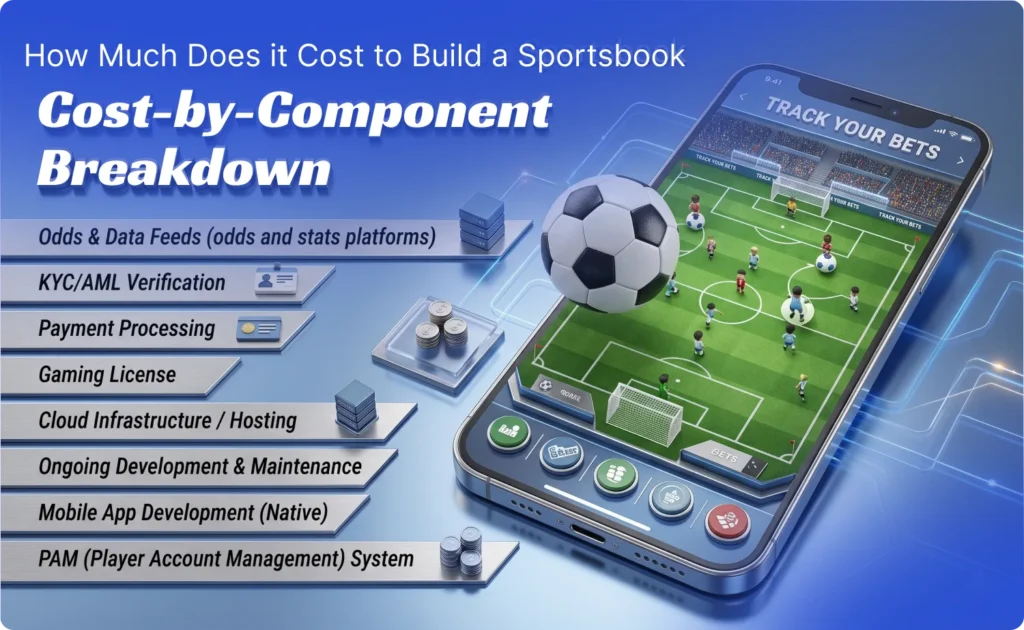
Platform choice is only one layer of the process. Your total cost of ownership (TCO) depends on a recurring stack that compounds monthly.
Live betting depth increases both fees and infrastructure load.
Volume discounts apply, but regulated markets increase checks (document + biometric + database).
Varies by geography, method mix (cards, wallets, APMs), and fraud profile. Chargebacks add overhead.
Includes application, legal, compliance audits, and ongoing reporting. Multi-jurisdiction expansion multiplies cost.
Driven by concurrency, in-play latency requirements, and redundancy. Peak events (World Cup) require burst capacity.
Covers bug fixes, feature releases, integrations, and compliance updates. Cost scales with roadmap velocity.
iOS and Android builds, plus ongoing updates and store compliance. Web apps reduce upfront cost but limit UX control.
Handles wallets, bonuses, segmentation, and reporting. Some platforms bundle PAM; others charge separately.
The GGR tipping point changes your sportsbook software development cost structure. With white label, a 20 to 40% revenue share looks manageable at low volume. Once you cross roughly $150K to $200K monthly GGR, that share becomes your largest expense line, often exceeding fixed costs of a turnkey setup. At that point, switching models accelerates ROI.
Other commonly missed costs of sportsbook software are as follows.
If you ignore these costs, your margin projections will not hold.
Yes, the overall cost for building sports betting software can be high if you are going for more customization and ownership. However, if you move as per a strategy, the cost factor can be controlled.
Each market adds licensing, legal, KYC vendors, reporting, and tax logic.
Real-time pricing, low-latency feeds, and risk management infrastructure increase both vendor fees and hosting costs.
Native delivers retention and UX control, but adds a six-figure build and ongoing maintenance.
Add-on modules like casino, payment rails, CRM, affiliate tracking, and anti-fraud systems add setup and recurring sportsbetting software costs.
Advanced trading models and personalization improve margin but require data pipelines, compute, and specialist teams.
An MVP is a beginner-level product that you can use to prioritize core markets and sports. It allows you to validate acquisition channels and retention before expanding feature scope.
An API-first approach is cost-effective. Therefore, swap vendors without full rebuilds. Negotiate better rates as volume grows.
Choose vendors with clear pricing and exit flexibility. Lock in SLAs and data ownership.
Your stage in the business funnel determines the correct sportsbook software development cost structure.
| Stage | Model |
|---|---|
| Pre-launch / Market validation | Model: White label Budget: $60K to $200K (year one) Goal: Test product-market fit, acquisition channels, and initial retention without heavy capex. |
| Scaling operator (proven GGR, margin focus) | Model: Turnkey Budget: $150K to $600K Goal: Eliminate revenue share, control pricing, and improve contribution margin. |
| Enterprise / Multi-brand / B2B | Model: Custom Budget: $800K+ Goal: Own IP, build differentiated features, support multiple brands and jurisdictions. |
Timing note for 2026:
If you aim to capture World Cup liquidity or enter newly regulated LatAm markets, start procurement now. Quality vendors carry 8 to 16 week lead times before the build even begins. Delay compresses your testing window and inflates acquisition costs.
The sportsbook software development cost in 2026 is not a single figure; it’s a structural decision that shapes your TCO, margin, and scalability. Choose speed (white label) and pay in revenue share, or invest upfront (turnkey/custom) to capture long-term profit. Align your model with GGR ambition, time-to-market pressure, and compliance footprint.
If you’re evaluating options, you can get a consultation from the experts at TIG Sportsbook and explore our sportsbook solutions for rapid launch. Book a demo to get an estimated cost of sports betting software solutions based on your requirements and model for long-term ROI.