

Sports Betting Payment Solutions & Payment Gateway Integration
Sports Betting Payment Solutions & Payment Gateway Integration Table of Contents Today, the gambling process has become easier than before. You place a bet, pay, and if you win, receive


Key Takeaways
A sportsbook bonus engine is the rules system with eligibility, wagering requirements, caps, and triggers that govern how promotions are issued and settled. A well-designed engine balances retention & margin by tying bonus cost to NGR rather than GGR. This helps in enforcing rollover multiples of 3x to 8x, and flagging abuse patterns before payout, keeping bonus-to-NGR ratios sustainable.
When it boils down to player acquisition and retention efforts, operators primarily focus on bonuses and other promotions. However, this is not always an effective strategy. Here’s how.
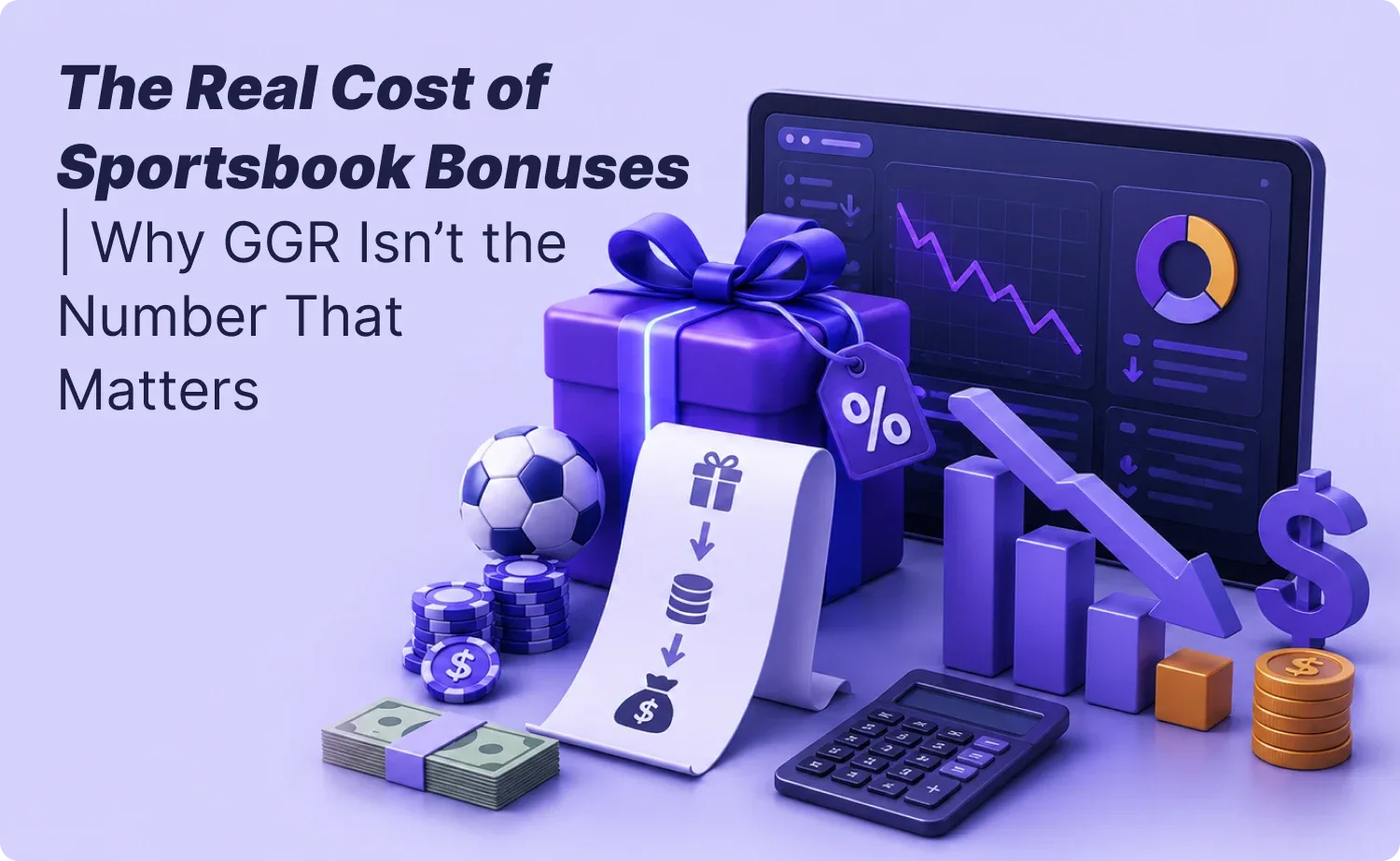
If you look carefully at it, bonuses are the most expensive line item that most sportsbook operators never actually measure. Yes, a welcome offer or an odds boost can look like a simple acquisition cost on a spreadsheet
But multiply it across thousands of signups, reload promos, & VIP cashback tiers, and it can quietly become one of the largest drains on net gaming revenue (NGR) in the entire business. The problem here is that there is no oversight entity.
A sportsbook bonus engine fixes this. It is a structure of rules, triggers, caps, & wagering requirements that determines whether a bonus actually buys loyalty or just buys a withdrawal.
In this guide, we will learn about the bonus types that matter, how to model their true cost against NGR rather than GGR, & the framework operators use to design promotions that retain players without quietly eroding the bottom line.
A sportsbook bonus engine is the brain behind the issuance, tracking, and settlement of bonuses and promotions. While a bonus is a one-time offer, such as a deposit match or a free bet, the bonus engine is the logic layer sitting behind it, which includes
Though offering a single bonus might not hurt the operator, when seen as a combination of thousands, it can deplete revenue and boost acquisition cost. A bonus engine can ensure that
This leads to centralization of eligibility logic, wagering requirements, sportsbook, expiry & forfeiture rules, and sportsbook bonus abuse detection.

In sports betting, there are several types of bonuses and promotions. However, their nature and overall impact on the margin are not the same. For example, a deposit match drives acquisition but leaks margin if rollover terms are soft. On the other hand, a loyalty cashback program builds retention but compounds cost at high VIP tiers.
To build a promotion mix that delivers high acquisition with less cost, understanding their impact on margin is critical.
| Bonus Type | Typical Cost (% of GGR) | Retention Effect | Abuse Risk |
|---|---|---|---|
| Welcome / Deposit Match | 15% to 25% of GGR in the acquisition period | High for new player activation. Low long-term stickiness if rollover requirements are weak. | High. Primary target for bonus hunters and multi-accounting. |
| Free Bets / Risk-Free Bets | 8% to 15% of GGR based on the liability cap | Moderate. Drives first-deposit action but has limited impact on repeat behavior. | High. Easily arbitraged through opposing bets on exchanges. |
| Odds Boosts | 3% to 8% of GGR per boosted market | Low to moderate. Increases session engagement rather than long-term loyalty. | Low to moderate. Operator exposure is capped by the boost limit. |
| Parlay Insurance / Profit Boost | 5% to 12% of GGR | Moderate to high. Encourages parlay betting that increases overall handle. | Low. Complex payout structures reduce abuse opportunities. |
| Reload & Reactivation Bonuses | 6% to 10% of GGR | High. Among the most cost-efficient tools for re-engaging inactive players. | Moderate. Less attractive to professional bonus hunters than welcome offers. |
| Loyalty / VIP Cashback | 10% to 20% of GGR at upper tiers | Very high for high-value players. Limited impact on low-volume users. | Low. Account history and wagering-volume requirements filter out opportunistic abuse. |
Note: The cost figures in the table are indicative industry ranges and will vary based on rollover multiples, odds restrictions, player segmentation, and market. Operators should model bonus cost against NGR, not GGR, using their own platform data before setting promotion budgets.
The highest-abuse-risk bonuses are welcome offers and free bets. These are the most commonly over-invested in, because acquisition metrics are more visible than the margin erosion that follows.
Besides, reload and reactivation bonuses deliver strong retention at a lower cost and lower abuse risk than most operators assume, making them structurally underused in most sportsbook promotion strategy mixes.
Most operators track bonus spend as a percentage of GGR. It’s an easy number to pull, and it looks manageable on a report. The problem is that GGR is the wrong denominator.
GGR is revenue before bonuses and other marketing efforts are deducted. Using it to measure bonus cost is circular. It obscures how much of your actual retained revenue is being consumed by the promotions meant to generate it.
The operative metric is not the bonus cost to GGR ratio but the bonus to NGR ratio. This is the percentage of net gaming revenue, after bonuses, taxes, and payment costs, that is being returned to players in the form of promotional spend.
An operator running a 20% bonus-to-GGR ratio might assume that’s sustainable. But if bonuses, taxes, and payment processing together consume 60% of GGR, the effective bonus-to-NGR ratio is closer to 50%.
The primary lever controlling this ratio is the wagering requirement. Rollover multiples, such as those set between 3x and 8x the bonus amount, determine how much a player must wager before a bonus converts to withdrawable cash.
A 1x rollover on a $100 free bet costs near full face value. A 5x rollover on the same offer, restricted to odds of -200 or longer, reduces real liability significantly.
Here is a concrete example!
An operator offers a $100 deposit match with a 3x rollover requirement. The player wagers $300 across several bets, loses $180 net, and withdraws the remaining $120. The operator’s real bonus cost isn’t $100; it’s $100 minus the margin earned on $300 of handle. At a 5% hold rate, that’s roughly $15 recovered, making the net bonus liability approximately $85. Run the same offer at 6x rollover with a -150 odds floor, and the recovered margin increases to ~$30, reducing net liability to $70. Across 10,000 bonus redemptions, that $15 difference per redemption is $150,000 in protected NGR.
For an operator, setting the right wagering requirements helps turn promotional spend into a recoverable margin. There are primarily three factors that control this.
Today, most of the operators design bonuses and promotions based on reactive needs, such as
However, if you want to maximize player acquisition and reduce bonus abuse, a custom sportsbook promotion strategy is required. Here is how you can build one.
A sportsbook bonus engine is not a feature but a critical financial control system. Operators who treat promotions as isolated marketing decisions consistently overspend on acquisition, underinvest in retention, and leave abuse vectors open until they show up as margin erosion on a monthly report.
The operators who get this right share one trait: they engineer the system before they launch the offers. Segmentation, trigger logic, cost ceilings, rollover calibration, and fraud rules built in from the start produce promotion programs that compound retention without compounding cost.
If you are building a sportsbook platform or restructuring an existing sportsbook promotion strategy, the bonus engine architecture decisions made early determine the margin outcomes felt for years. Get a professional consultation from TIG Sportsbook to see how our platform handles bonus engine configuration out of the box.
A sustainable bonus-to-NGR ratio typically sits between 15% to 25% for acquisition-focused operators and 8% to 12% for mature platforms prioritizing retention. Ratios above 30% are a structural warning sign that indicates that your promotional spend is outpacing the margin being generated, regardless of how healthy GGR looks on the surface.
Wagering requirements define how much a player must bet before bonus funds convert to withdrawable cash. A 5x rollover on a $100 bonus means $500 in qualifying wagers must be placed first. Operators use rollover multiples, odds floors, & expiry windows together to control how much of the bonus liability is actually paid out versus forfeited.
Most platforms flag abuse through a combination of behavioral and technical signals, such as
The strongest setups embed these checks into issuance logic rather than reviewing after payout.
Sports Betting Payment Solutions & Payment Gateway Integration Table of Contents Today, the gambling process has become easier than before. You place a bet, pay, and if you win, receive

Omnichannel Sportsbook Architecture: Web, Mobile & Retail in One Back Office Table of Contents Quick Summary Hide Summary An omnichannel sportsbook runs web, mobile & retail on one core: One

Sportsbook Mobile App Development: Cost, Timeline, and Feature Breakdown for Operators Table of Contents Key Takeaways Hide Summary Sportsbook mobile app development costs range from $15,000 (white-label) to $300,000+ (custom