For sportsbook operators, the fastest and best way to boost customer acquisition is via an app. Why?
As per stats, 57% of Americans who bet on sports today say they didn’t gamble on sporting events at all before these apps existed. These stats underscore the need for a sportsbook mobile app for operators. Now, when it boils down to sportsbook mobile app development, there are several factors that surface, such as sports betting app development cost, timeline, features, and more.
Today, sportsbook mobile app development cost varies based on the deployment model, feature requirements, compliance obligations, & long-term ownership strategy. Sports betting app development cost typically ranges from $15k to $50k for white-label mobile integrations to $80k to $300k+ for fully custom native iOS and Android applications with complete source code ownership.
In this guide, you will learn the real cost of sportsbook app development, the key factors that influence pricing, and app deployment models.
Sportsbook Mobile App Development Cost | The Operator’s Real Number
White-Label Mobile App
Branded UI built on an existing sportsbook engine$15,000 to $50,0003 to 6 weeks
| Deployment Model | What You Get | Typical Cost Range | Timeline |
|---|
| Turnkey with Mobile Layer | Full sportsbook platform with native iOS and Android apps included | $50,000 to $150,000 | 2 to 3 months |
| Custom Native App (iOS + Android) | Fully bespoke mobile apps with source code ownership and custom UX | $80,000 to $300,000+ | 7 to 9 months |
Note: The cost figures mentioned in the table are industry estimates and may change based on individual business needs.
The difference in sportsbook mobile app development cost is not driven by UI features alone. It is fundamentally determined by
- Architecture ownership
- Compliance depth
- Long-term total cost of ownership (TCO)
While white-label and turnkey models appear cost-efficient at the entry point, they rely on shared infrastructure, which limits control over product logic, margins, & scaling flexibility.
Stay Ahead of Sports Betting Market Trends
Core Features That Drive Sportsbook App Development Cost
Operators do not pay just for sportsbook app features for operators. Yes, they matter a lot, but the very underlying infrastructure that keeps these features stable, compliant, & scalable under real-time betting load makes them valuable.
In sportsbook mobile app development, each feature directly impacts backend complexity, data processing architecture, third-party dependencies, & long-term maintenance cost.
Tier 1. Non-Negotiable (Baseline Cost Drivers)
| Feature | What It Actually Requires to Build Correctly |
|---|
| Live in-play betting engine | - Low-latency streaming architecture
- Real-time data synchronization
- High-availability backend systems
|
| Biometric authentication | - Secure identity layer integrated with device-level authentication APIs
- Fallback security logic
|
| Integrated player wallet + payment gateway | - PCI-compliant wallet system
- Multi-provider payment routing
- Transaction reconciliation infrastructure
|
| Push notifications | - Event-driven messaging system connected to betting engine and user segmentation logic
|
| KYC/AML compliance + geolocation enforcement | - Regulatory compliance engine
- Identity verification APIs
- Jurisdiction-based access control
|
Tier 2. Competitive Differentiators (Mid-Tier Cost Drivers)
| Feature | What It Actually Requires to Build Correctly |
|---|
| Bet builder / same-game parlay engine | - Complex odds aggregation logic
- Real-time combinational pricing engine
|
| Personalized dashboards (AI-driven recommendations) | - Behavioral data pipelines
- Recommendation models
- Real-time personalization layer
|
| Cash-out module (partial + full) | - Dynamic risk recalculation engine tied to live odds movement and liquidity exposure
|
| Multi-currency + crypto wallet support | - Multi-ledger financial system with FX conversion logic
- Blockchain/payment gateway integration
|
Tier 3. Enterprise-Grade Sportsbook Features (Premium Cost Drivers)
| Feature | What It Actually Requires to Build Correctly |
|---|
| AI-powered risk management & fraud detection | - Machine learning models for anomaly detection
- Betting pattern analysis
- Exposure control systems
|
| Live streaming integration | - CDN-based streaming infrastructure
- Latency optimization
- Content rights management systems
|
| Retail + omnichannel synchronization | - Unified player identity architecture connecting retail POS, mobile, and online betting systems
|
| Multi-jurisdiction compliance layers (MGA, UKGC, GGL) | - Modular compliance engine with jurisdiction-specific rule enforcement, reporting, and audit trails
|
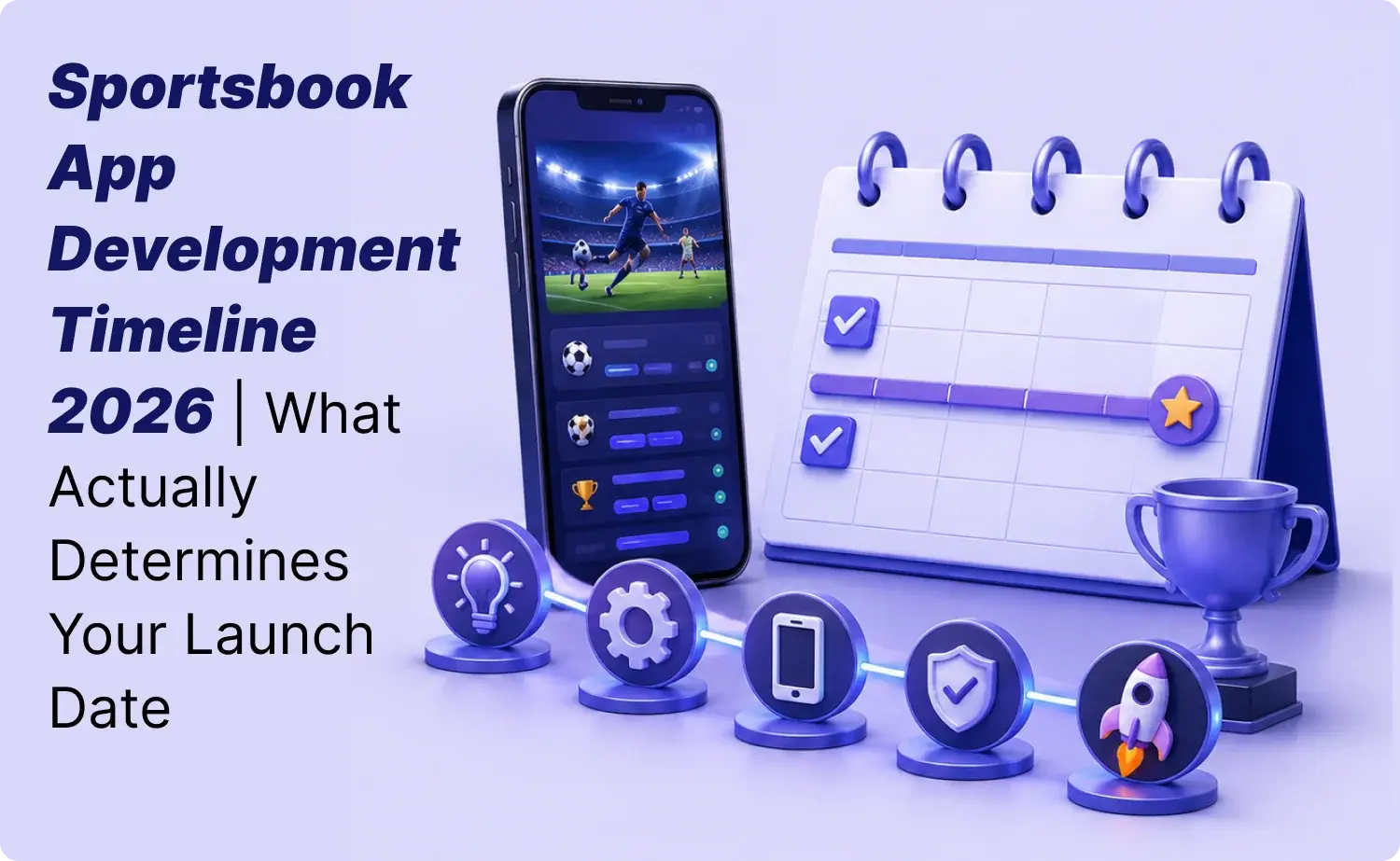
Sportsbook App Development Timeline 2026 | What Actually Determines Your Launch Date
Most discussions around how long to build a sportsbook app focus on generic build durations. However, in practice, launch speed is determined less by coding effort and more by aspects like
- Operator-side decisions
- Regulatory readiness
- Third-party dependency alignment
In 2026, how long it takes to build a sportsbook app depends on five critical phases that either compress or significantly extend delivery time.
- Licensing and jurisdiction decision: This is often the most time-consuming factor. If regulatory approval is not already secured, operators may lose 4 to 12 weeks or a year aligning with jurisdiction-specific requirements, which includes KYC standards, geo-restrictions, and compliance documentation.
Note: States like Illinois take 14 months on average for combined casino sportsbook licenses.
- Deployment model selection (turnkey vs. custom): The next major determinant. Turnkey and white-label solutions can accelerate launch to weeks. But custom native builds extend timelines into multiple months due to specific architectural design, sprint cycles, & infrastructure provisioning.
- Third-party integrations: Integrations like odds feed providers, payment gateways, and KYC vendors each operate on separate SLAs. If there is any misalignment between them, it can create hidden delays in staging & production readiness.
- App store review cycles: This is another dependency layer. While Apple App Store reviews typically take 1 to 3 days, gambling applications often require pre-approval depending on jurisdiction, especially in fragmented markets such as the United States.
- QA and compliance UAT: This is one of the most critical steps and is frequently underestimated. Production-grade sportsbook apps require 2 to 4 weeks of structured testing across betting flows, payment systems, & regulatory compliance checks before launch readiness.
Quick Abstract: Operators who enter development with licensing resolved and a clearly defined deployment model can launch within 2 to 3 months using turnkey or white-label solutions. On the other hand, fully custom sportsbook apps with source code ownership typically require 7 to 9 months, depending on integration complexity & jurisdictional scope.
Native App vs. White-Label Mobile: Which Model Fits Your Stage?
If you are an operator evaluating sportsbook app development cost and deployment strategy, here is what you must understand.
The choice between native apps, white-label solutions, and turnkey systems is about your
- Business stage
- Regulatory readiness
- Growth ambition
Each model serves a distinct operational scenario, particularly when balancing speed-to-market against long-term platform control.
Native App vs. White-Label Mobile: Decision Matrix for Operators
| Operator Scenario | Recommended Model |
|---|
| Entering a new regulated market, need to launch in under 6 months | Turnkey |
| Scaling beyond 100,000 active users and requiring full control and extensibility | Custom native iOS + Android app |
| Testing product-market fit in a regulated jurisdiction | White-label |
Operators should evaluate this decision not only on sports betting app development cost, but also on long-term control over product evolution, compliance flexibility, and revenue retention.
Operators who choose TIGSportsbook’s custom development path receive full source code ownership on delivery. This entirely bypasses ongoing licensing dependency & removes long-term revenue share constraints.
Hidden Costs Operators Underestimate in Sportsbook App Development
The published sportsbook mobile app development cost is only one part of the investment. Besides initial development, operators should account for several recurring operational & regulatory expenses that directly affect long-term profitability.
These hidden costs are often overlooked during vendor evaluation, but they can become significant as the platform scales.
App Store Distribution Fees
Apple generally charges up to 30% on eligible digital in-app purchases, while gambling apps may also incur add-on costs, such as
- Compliance cost
- Legal cost
- Review costs
These depend on the jurisdiction and business model.
Odds Feed Licensing
Premium sports data providers like Sportsradar, LSports, and more typically charge on a per-sport, per-market, or per-jurisdiction basis. Expanding into new leagues or regulated markets can substantially increase ongoing licensing expenses.
Ongoing Maintenance and Platform Updates
Production-grade sportsbook apps generally require 15% to 20% of the original development cost annually for aspects such as
- Operating system compatibility
- Security patches
- Performance optimization
- Feature enhancements
Third-party KYC and AML Verification Fees
Identity verification providers commonly use per-verification or transaction-based pricing, making compliance costs directly proportional to player acquisition and verification volumes.
Post-launch Compliance Audits
Licensed operators under regulators, such as
- The Malta Gaming Authority (MGA)
- UK Gambling Commission (UKGC)
- Germany’s GGL
Should budget for periodic technical audits, security assessments & compliance certifications to maintain regulatory approval.
Factoring these recurring expenses into your sports betting app development cost calculation provides a more accurate view of total cost of ownership (TCO) and helps prevent unexpected operational costs after launch.
Conclusion
Based on the overall analysis, it is clear that the cost and timeline of sports betting mobile app development depend on a number of factors. Each factor has to be analyzed carefully to get an accurate figure.
If you are evaluating sportsbook mobile app development options for 2026, TIG Sportsbook can help you with it. TIG Sportsbook provides native iOS & Android apps across every deployment model, including turnkey, custom, & white-label.
No matter if your priority is rapid market entry or full source code ownership, our team helps you choose the right architecture with transparent pricing & realistic delivery timelines.
Book a demo today to receive a tailored project consultation!
Are you ready to optimize your sportsbook’s performance?