

Sports Betting Payment Solutions & Payment Gateway Integration
Sports Betting Payment Solutions & Payment Gateway Integration Table of Contents Today, the gambling process has become easier than before. You place a bet, pay, and if you win, receive


Key Takeaways
If you are an existing operator adding sportsbook as a vertical, choose iFrame if you need to launch in under 30 days or less, have no dedicated sportsbook engineers, and don’t require a custom betslip UI. Choose API if you have 4+ in-house sportsbook developers, a pixel-level brand requirement on the betting interface, or a jurisdiction mandating operator ownership of the user-facing application.
So, you have a running online casino, the PAM is performing well, and your players are active. Now, you want to add a sportsbook vertical. As an operator, the first technical decision that needs to be made is one of the most consequential ones: do you integrate via iFrame or API?
Whether you are integrating it in a new iGaming platform or in an existing one, the decision is not about which technology is better. It is about which sportsbook software integration options fit the platform you have already built, the engineering team you actually have, and the timeline your business can realistically operate within.
No matter if it is sportsbook API integration or sportsbook iframe integration, the correct decision can take your business months ahead of your competitors.
In this guide, you will learn about both models, the real trade-offs between them, and the decision framework operators use to make the right call for their specific situation.
A sportsbook iFrame embeds a fully operational betting interface directly into your existing website using a single line of code. This is entirely comparable in effort to embedding a video player, but delivering an entire sportsbook experience.
From your player’s perspective, they never leave your platform.
From your engineering team’s perspective, they never touch betting infrastructure.
The entire sportsbook layer is vendor-managed and updated without operator involvement, including
What sportsbook iFrame integration means: A pre-built, fully hosted sportsbook interface that embeds into an operator’s existing platform via a single code snippet, with the vendor managing all betting infrastructure, including odds, markets, settlement, and risk, while the operator retains wallet control and brand presentation.
Sportsbook API integration gives your engineering team
With these, your team builds the front-end to add a sportsbook to the existing platform. You own every pixel of the user experience. The vendor supplies the infrastructure and the data; you supply the product and the interface.
This model requires meaningful engineering investment that includes
With this trade-off, operators get complete ownership of the UX, the data, and the product roadmap.

| Factor | iFrame Integration | API Integration |
|---|---|---|
| Time to Go Live | 1 to 3 weeks | 2 to 5+ months |
| Development Resources Required | Minimal (embed + configuration) | 4 to 6 dedicated engineers |
| UI/UX Control | Brand-level theming | Full pixel-level ownership |
| Data Ownership | Provider-side | Operator-side |
| Integration Complexity | Low (single embed) | High (full-stack build) |
| Ongoing Maintenance | Provider-managed | Operator-managed |
| Compliance Responsibility | Vendor-handled | Operator-handled |
| Best Fit | Casino and iGaming operators who plan to embed a sportsbook on their existing website. | Large operators with in-house product teams. |
Note: The two rows that matter most for an existing platform operator are time to go live and dev resources required.
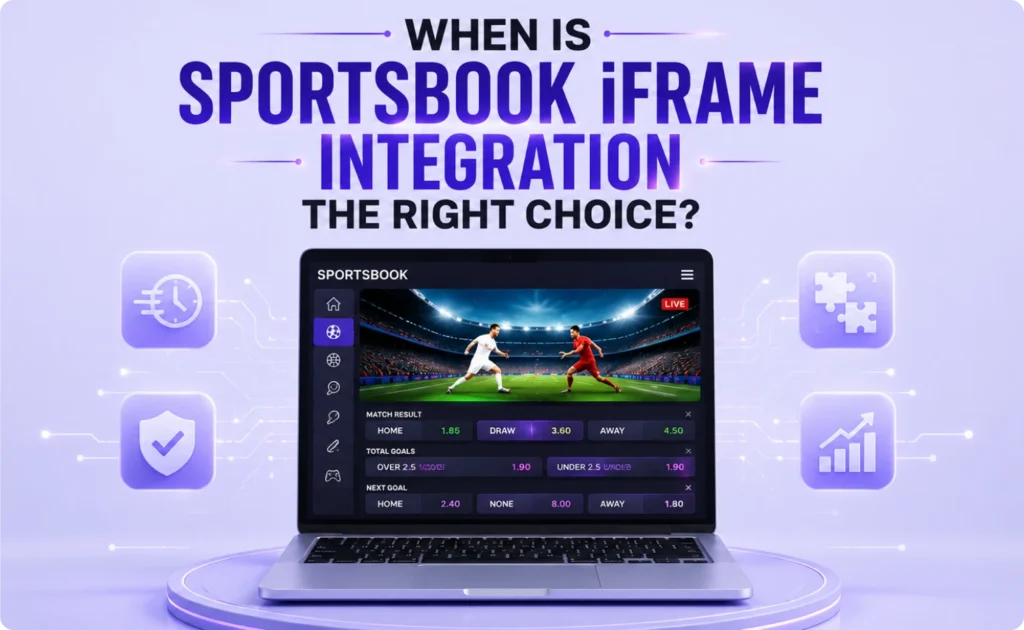
iFrame is the right model when your existing platform is already doing what it needs to do, and you are adding sportsbook as a revenue vertical, not rebuilding around it.
Your differentiation isn’t the betslip. For most casino-first operators, the competitive advantage lies in
It is not in having a proprietary bet-slip layout or an in-house custom-made UI.
API integration is not the wrong answer. It is the right answer for a specific operator profile. Being clear about that profile matters.
Most operators evaluate iFrame vs. API on features. The ones who have run both compare them on cost. Over a five-year window, the gap is not marginal.
On a $10M GGR sportsbook, iFrame TCO is almost entirely vendor cost, which includes
Five years of a flat vendor fee, typically in the range of $18,000 to $36,000 annually for a mid-tier iFrame platform, is under $200,000 in total vendor spend.
API integration on the same revenue base looks structurally different.
Year 1 requires four to six dedicated sportsbook engineers across frontend, backend, DevOps, and QA. At fully loaded engineering costs of $100,000 to $140,000 per engineer in most EMEA and North American markets. This is $400,000 to $840,000 in engineering spend in year one alone before the vendor’s API platform fee, which on tier-1 contracts adds a further $200,000 to $500,000 annually.
Years two through five require a sustained team of two to three engineers for maintenance, iteration, and compliance updates. This, plus continued API licensing. By year five, a fully loaded API built on a $10M GGR operation typically carries a total cost of ownership in the $3M to $5M range.
| Cost Element | iFrame (5-Year) | API Integration (5-Year) |
|---|---|---|
| Vendor Platform Fees | $90K to $180K | $1M to $2.5M |
| Engineering (Build + Maintain) | Effectively $0 | $2M to $3M+ |
| DevOps / QA Overhead | Absorbed by the vendor | $200K to $500K |
| Estimated 5-Year Total Cost of Ownership (TCO) | ~$90K to $200K | ~$3.5M to $5M |
Note: These are industry-range estimates and may not match the exact cost numbers.
Most operators overthink this decision because they are weighing abstract capabilities instead of concrete constraints. These three questions cut through it.
If the answer is under three months, iFrame is the only model that delivers within that window. API builds don’t matter regardless of team size or vendor promises.
If yes, if your brand promise requires a custom, pixel-perfect betting interface, API is the right foundation, and the engineering investment is justified.
If your differentiation lives in markets, retention mechanics, or geographic positioning, iFrame delivers full feature parity without the build cost.
An API front-end isn’t a build-once project. It also requires
Under three dedicated sportsbook engineers, the operational burden of an API-built front-end creates compounding technical debt. iFrame collapses that surface to a vendor-managed layer.
TIGSPORTSBOOK offers both integration paths from the same underlying infrastructure, which matters for operators who want to start fast and scale later.
The iFrame solution deploys in 21 days with 50+ sports, 100,000+ monthly events, full live betting and cash-out functionality, and a geo-tailored UI that matches your brand without developer involvement. Your existing PAM, wallet, and CRM remain untouched.
The API integration connects your custom front-end to 60,000+ live events, 2,000+ betting markets, and sub-second odds delivery with a 99.9% uptime SLA. Your front-end build timeline is separate and depends on the scope.
Both options are built for operators who are already running a platform and need to add a sportsbook without disrupting what’s already working. The right starting point depends on where you are, not where you plan to be.
Book a demo to map the right integration path for your platform!
iFrame embeds a fully managed, vendor-hosted sportsbook interface into your existing platform using a single code snippet. Here, the vendor handles all betting infrastructure. API integration provides the data layer so your team can build a custom front-end.
iFrame is faster and requires fewer engineering resources; API offers more UI control and data ownership.
Yes, and it's a common path. Many operators launch via iFrame to capture early revenue while their product team builds a custom front-end against the API.
A vendor who supports both models on the same infrastructure makes that transition significantly cleaner.
For most casino-first operators adding sportsbook as a vertical, iFrame is the lower-risk and faster path. It doesn't require changes to your existing wallet, PAM, or KYC infrastructure, and it can go live in weeks rather than months without pulling your engineering team off your core product.
Sports Betting Payment Solutions & Payment Gateway Integration Table of Contents Today, the gambling process has become easier than before. You place a bet, pay, and if you win, receive

Omnichannel Sportsbook Architecture: Web, Mobile & Retail in One Back Office Table of Contents Quick Summary Hide Summary An omnichannel sportsbook runs web, mobile & retail on one core: One
Sportsbook Mobile App Development: Cost, Timeline, and Feature Breakdown for Operators Table of Contents Key Takeaways Hide Summary Sportsbook mobile app development costs range from $15,000 (white-label) to $300,000+ (custom