
Sports Betting Payment Solutions & Payment Gateway Integration
Sports Betting Payment Solutions & Payment Gateway Integration Table of Contents Today, the gambling process has become easier than before. You place a bet, pay, and if you win, receive


Key Takeaways
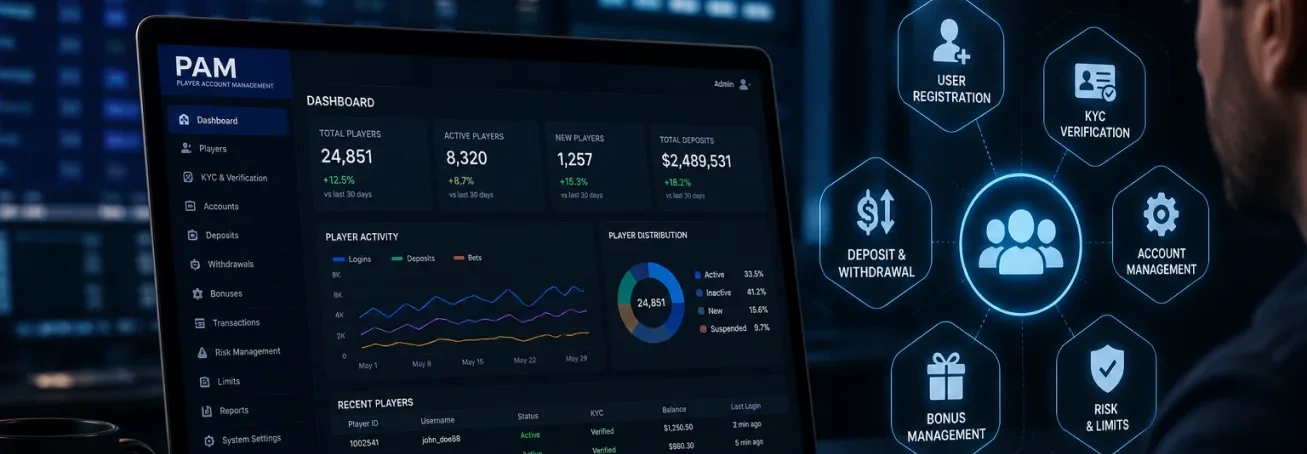
Sportsbook PAM software, or the sportsbook Player Account Management system, is the centralized back-office system that manages every player-facing operation on a sports betting platform. This includes everything from registration, KYC verification, and wallet management through bonus allocation, fraud detection, and regulatory compliance enforcement, all from a single operator-controlled interface.
Today, when an operator begins their sports betting journey, their primary focus is on odds feeds, risk management, and front-end design. It is agreeable that these are important elements, but not more than sportsbook PAM software. Operators treat the player account layer as something they will figure out after launch, a back-office concern rather than a foundational one.
This assumption costs operators as they figure out issues faster, including compliance workflows breaking down, player onboarding stalling, wallets not reconciling cleanly under live-event load, and every fraud or bonus abuse incident requires manual intervention.
For a sportsbook, the PAM isn’t a feature you add. It’s the infrastructure that makes a sportsbook operationally viable. Let’s read ahead and break down the player account management sportsbook in detail.
At its core, a sportsbook PAM manages five distinct functions that determine whether a betting platform runs cleanly or creates compounding operational debt.
The player management on a sportsbook begins way before the first bet is placed. PAM handles
In a well-configured sportsbook system, this sequence is fully automated and jurisdiction-configurable. An operator launching in multiple markets doesn’t rebuild the onboarding flow for each one. The PAM applies the correct rule set at the account level based on where the player is registering.
This is where most generic solutions create real problems for sportsbook operators. You see, real-money funds, free bet credit, pending withdrawals, and crypto holdings can’t share a single ledger without creating reconciliation errors. This usually happens during high-volume live events when thousands of bets are being placed & settled simultaneously.
A sportsbook PAM maintains all of these as separate ledgers. This allows for independent tracking and configurable rules governing how each balance type can be used and withdrawn.
A PAM software for sports betting operators ensures that compliance runs continuously, not just at onboarding.
Several aspects are configured once in the PAM’s compliance engine and enforced automatically across every player action, such as
For regulated markets, this removes manual compliance overhead & significantly reduces the regulatory exposure that comes from inconsistent enforcement.
In the sportsbook context, bonus and promotions management is operationally more complex than in a casino environment. Aspects like
need to be managed natively and not approximated.
In a sportsbook, fraud detection operates at the account level and in real time. A sportsbook PAM monitors behavioral signals, such as
This helps in flagging multi-accounting and bonus abuse before payouts are processed rather than after.

This is the question most operators don’t think to ask until they have already committed to the wrong vendor.
Was this PAM built for sportsbook operations, or was it built for casino and then adapted?
The distinction matters because the operational logic of sports betting is fundamentally different from casino gaming.
A sportsbook introduces operational complexity that the casino PAM infrastructure simply wasn’t designed to handle.
The compliance engine gap is particularly significant. Responsible gambling obligations for sports betting include
The key evaluation question for any PAM vendor.
Was the compliance engine and wallet architecture designed around sportsbook operational logic from the start, or was it adapted from a casino infrastructure?
Note: When evaluating vendors, operators should request specifics about how the PAM handles in-play session events, concurrent live-event wallet reconciliation, and staking velocity monitoring. Vague answers to those questions typically indicate casino-derived architecture.

Understanding what a PAM does is critical. It helps you understand what capabilities a sportsbook PAM must include before you commit to a vendor.
The PAM software needs to cover
It needs to run these checks continuously throughout the player lifecycle, not just at registration. Jurisdiction-specific rule sets should be configurable independently per market, not applied as a single global policy.
This is a non-negotiable feature for sportsbook operations. Real money, free bet credit, pending withdrawals, and crypto holdings each need independent ledger tracking.
Every credit and debit is a financial event requiring an immutable record and a complete audit trail. ACID compliance at the transaction level is the baseline feature to have.
This feature must go beyond basic transaction monitoring. Behavioral analysis at the account level must include
This separates a PAM that actually prevents bonus abuse and multi-accounting from one that logs it after the fact.
These tools in a PAM handle free bet triggers, enhanced odds offers, and market eligibility rules as configurable parameters, not as workarounds using generic casino promotion logic.
Player segmentation for retention campaigns should run from within the PAM without requiring data exports to a separate CRM platform.
With these features, operators get real-time visibility across
Separate views for finance, compliance, and marketing teams operating on the same data set are operationally important at scale.
This is one of the sportsbook PAM software features that matters from day one for any operator building toward market expansion.
Managing player environments across brands and jurisdictions from a single centralized dashboard with independent compliance configurations per brand eliminates the infrastructure duplication that creates cost and audit complexity at scale.
| Factor | Standalone PAM Platform | Sportsbook PAM Integration (API) |
|---|---|---|
| Best For | Operators building or rebuilding their platform from scratch. | Operators with an existing sportsbook platform upgrading their player management layer. |
| Deployment Model | Complete, pre-integrated Player Account Management (PAM) solution. | Connects a PAM layer to an existing platform via APIs. |
| Core Capabilities |
| Existing sportsbook enhanced with centralized player management and compliance features. |
| Infrastructure Requirement | New PAM deployment with integrated modules. | Retains existing sportsbook infrastructure. |
| Migration Approach | Fresh deployment. | Parallel run with the existing system to minimize go-live risk. |
| Ideal Use Case | Launching a new sportsbook or replacing legacy player management. | Modernizing player account management without replacing the sportsbook platform. |
A fragmented player management stack doesn’t just create operational friction. It creates compounding risk across compliance, revenue, and player trust.
Operators running without a unified PAM consistently run into the same five failure points:
The honest answer is any operator running a compliant, scalable sports betting platform. But the need looks different depending on where an operator is in their build.
There are four criteria that should anchor any vendor evaluation.
Moreover, confirm that the API layer has documented connectors for the KYC vendors, payment gateways, and odds feed platforms your operation requires.
Custom connector builds for every integration add timeline and technical risk that a well-integrated PAM should eliminate.
A sportsbook PAM isn’t a back-office add-on but a system that determines whether a sports betting platform can onboard players cleanly, enforce compliance continuously, process transactions accurately at scale, and retain players through data-driven engagement.
Operators who treat PAM selection as an afterthought typically pay for it twice: once in operational overhead, fixing what the system can’t do, and again when a compliance gap surfaces in an audit.
TIGSportsbook’s Player Account Management software is built specifically for sportsbook operations covering the full player lifecycle, multi-wallet architecture, KYC and AML compliance, fraud detection, and CRM tooling in a single system. Book a demo to see it in action!
Sportsbook PAM software is a Player Account Management system built specifically for sports betting operations. It manages the full player lifecycle, such as
A casino PAM is designed around spin-cycle session behavior and game-round transaction flow. A sportsbook PAM must handle live in-play session events, multi-market wallet reconciliation under concurrent bet settlement, staking velocity monitoring, and event-triggered bonus logic.
Yes. A sportsbook PAM deployed via RESTful API connects to an existing platform through documented connectors for payment providers, KYC vendors, and sportsbook back-office systems. Parallel running during the transition keeps the existing platform operational until the new PAM layer is fully validated.
A capable sportsbook PAM should include
Sports Betting Payment Solutions & Payment Gateway Integration Table of Contents Today, the gambling process has become easier than before. You place a bet, pay, and if you win, receive

Omnichannel Sportsbook Architecture: Web, Mobile & Retail in One Back Office Table of Contents Quick Summary Hide Summary An omnichannel sportsbook runs web, mobile & retail on one core: One

Sportsbook Mobile App Development: Cost, Timeline, and Feature Breakdown for Operators Table of Contents Key Takeaways Hide Summary Sportsbook mobile app development costs range from $15,000 (white-label) to $300,000+ (custom